

The Power of the Gospel

On May 23, 2011, in Bible Studies, Romans, by Bob Burridge

Romans 1:17, “For in it the righteousness of God is revealed from faith to faith; as it is written, ‘The just shall live by faith.’ “


The Power of the Gospel

Studies In Paul’s Letter to the Romans
by Bob Burridge ©2011

Lesson 6: Romans 1:16-17


Long ago, a lone prophet sat waiting for God to answer him.

God’s prophet had become terribly confused and troubled. He wondered about the terrible times God’s people were going through. It was more than 600 years before the birth of Jesus Christ.

The northern tribes of Israel had been taken away as captives by Assyria over 100 years before. The remaining tribes of Judah were struggling with growing immorality in their nation. Their leaders were corrupt and self-seeking. Foreign nations were invading their cities. The Prophet Jeremiah warned that God would soon judge them with another captivity. The troubled prophet wondered why God was letting this happen.

So this prophet, broken hearted and perplexed, asked the Lord to explain this to him. He called out his questions to God, then he wrote in Habakkuk 2:1, “I will stand my watch And set myself on the rampart, And watch to see what He will say to me, And what I will answer when I am corrected.”

We don’t know if he stood gazing off at the sky or horizon from a literal guard tower. Very likely this was figurative language the prophet used of his vigilance, waiting for God’s reply. What could he tell the people to assure them? What would ease his own soul?

The answer he received was not exactly what he had asked for. In verses 2-4 he got his reply, “Then the LORD answered me and said: ‘Write the vision And make it plain on tablets, That he may run who reads it. For the vision is yet for an appointed time; But at the end it will speak, and it will not lie. Though it tarries, wait for it; Because it will surely come, It will not tarry. Behold the proud, His soul is not upright in him; But the just shall live by his faith.’ ”

Instead of explaining all the secret complexities of why he was allowing his people to suffer, instead of telling why he was allowing heathen nations to seem to prosper, instead of just dealing with the details of that particular moment in history, God gave Habakkuk a general principle that applied to all situations in all times.

God explained that there are two different groups of people. On the one hand there is the proud. He is the arrogant and self-important person. He imagines he has control of everything, and that he can figure it all out if he just had more information. He presumes some special right to know what’s going on and why it was happening. However, he is unsettled within. There is no inner comfort. His soul is not “straight” but misshapen. The more he demands to know why everything happens, the more frustrated he becomes.

Then there is the person who is called “just”, or as some translate it, “righteous”. He is a child of God. He lives by a powerful and comforting principle; “The righteous will live by his faith.”

The Hebrew word used by Habakkuk to describe this person is tsadiq (צדיק). It means that something or someone is “just” or “righteous”. It is an adjective based upon the noun tsedeq (צדק) which according to the Brown-Driver-Briggs Hebrew Lexicon is something “right, just, normal”. It is used of fair weights and measures, a just government and fair judiciary, and being right ethically. The adjective used in Habakkuk 2:4 applies these qualities to the person who is unlike the proud ones. He is right in God’s eyes.

However, God is perfectly holy. Habakkuk writes about God just a few verses later in this chapter, “You are of purer eyes than to behold evil, and cannot look on wickedness. …” (Habakkuk 1:13).

The righteous person knows he cannot measure up to that standard. Habakkuk tells us more about the characteristics of this person who is just. He will “live by his faith.”

The word for “faith” in Habakkuk 2:4 is actually the word for “faithfulness”, ‘emunah (אמונה). This is an adjective often used to describe God’s faithfulness in his promises to his people. Here it is used to describe the way righteous people are to live. It literally says, the one who is righteous will live by his “faithfulness” or “steadfastness”.

Instead of relying upon himself and his own rights or merits, instead of living as if he has to know the reasons for everything, instead of imagining that everything centers on his own comfort and idea of what is best, he lives by his faithfulness to God, trusting his Sovereign Lord.

His hope is anchored in the Sovereign power and sure promise of God himself, and he strives to live accordingly. He satisfies himself with what God has commanded and explained, and he trusts God’s wisdom and ultimate goodness in the things that confuse him.


Paul builds the whole book of Romans on this text from Habakkuk.

In setting up his main theme, the Apostle explains the gospel in Romans 1:16-17, “For I am not ashamed of the gospel of Christ, for it is the power of God to salvation for everyone who believes, for the Jew first and also for the Greek. For in it the righteousness of God is revealed from faith to faith; as it is written, ‘The just shall live by faith.’ ”

The word “gospel” is central in what Paul is presenting in this first chapter. From our study so far we have shown that the word “Gospel” literally means “good news”, “good message,” or “a good announcement”.

Isaiah spoke of the gospel long before God revealed himself in Jesus Christ. In Isaiah 52:7 he wrote, “How beautiful upon the mountains Are the feet of him who brings good news, Who proclaims peace, Who brings glad tidings of good things, Who proclaims salvation, Who says to Zion, ‘Your God reigns!’ ”

Paul’s message was that the good news promised in Eden and expected all through the ages had in his time come to completion in Jesus Christ.

The gospel is the power of God for salvation. It sets people free from their moral guilt before God. It really changes lives. Not all individuals will remain separated from God because of sin. There is a real promise of grace based upon the real sacrifice of the Savior in the lost person’s place.

Salvation does not come to all. The gospel is a promise that only causes hope in some. In all who are believing God’s promises, the gospel is a firm assurance. Faith is the major factor that distinguishes the two groups God told Habakkuk about. It distinguishes the two classes of men that are spoken of all through Paul’s letter to the Romans.

The promise was first made known to the Jews as God’s chosen people in ancient times. It was through them that the promises were explained and the Messiah was born. Now it was time, as Paul explained to the churches as he traveled, that the gospel was being extended to the other nations as well.


The heart of that gospel message is summarized by Paul in Romans 1:17

In Romans 1:17 he writes, “For in it the righteousness of God is revealed from faith to faith; as it is written, ‘The just shall live by faith.’ ”

By this gospel, this good announcement, the righteousness of God was made known. God is holy. His law shows us what that holiness demands. In Deuteronomy 6:25 God said through Moses, “Then it will be righteousness for us, if we are careful to observe all these commandments before the LORD our God, as He has commanded us.”

The word used for “righteousness” is a noun form from that same root word used later by God to Habakkuk. The word is tsedeqah (צדקה).

We know we are not that holy. We all fall short of full obedience. No one is righteous when compared with this perfect standard.

Any righteousness that we have comes to us as a gracious gift of God. We are declared to be holy in God’s eyes, not by what we have done or decided, but by what Jesus did in our place; both by his perfectly moral life, and by his death on the cross to pay for our existing guilt. The evidence of this work of righteousness in us is our confidence (faith) in God’s promise.

Faith is a badly distorted idea today. This is partly why so many misunderstand Paul and the Book of Romans. It is partly why there are so many ideas about what Christianity is or should be.

The Bible makes it clear that faith is not present as a natural part of us. Paul wrote to the Thessalonian believers about the wicked ones who had come in among them. He said of them, “… not all have faith.” (2 Thessalonians 3:2). Jesus said to his followers in John 6:44, “No one can come to Me unless the Father who sent Me draws him; and I will raise him up at the last day.”

This faculty of resting upon the true God and upon his word is absent from us in our fallen condition. Our spiritually dead nature cannot understand this principle of true faith which comes from God. Given this faulty perception of reality, the kind of “faith” people look to for their deliverance from their guilt is understood as simply having some kind of “trust”.

Fallen humans trust in things for one of two reasons. Most often they trust in something because of their observations and reasonings. We examine chairs before we trust them to hold us up. From our past experience with chairs we decide to trust certain ones to sit upon them, and to not rely upon others. We may decide that a certain medicine works because we have heard testimonies from people who have used it and found it effective. Someone may decide to believe in alien visitors to the earth in flying saucers based on some book , movie, or testimonies he hears. That reasoning may or may not be sound, and the evidence may or may not be reliable. These kinds of choices are not what the Bible means here by “faith”.

In contrast with that trust based upon experience and scientific evidence, some trust in things irrationally by taking a blind leap into the unknown. They may commit to the idea that all men are basically good simply because they choose to believe that. They may decide to believe in fairies just because they are nice things to believe in. People may decide to believe in some kind of god because they want hope. But mere irrational desperation and wishing are not the ingredients of a true redeeming type of faith.

The rational method will fail because our fallen hearts will prejudicially deduce a different god than the one who really made all things. Only fools leap blindly to rest in something with no reason to believe it is reliable. These kinds of trust are possible even in the fallen mind, but they are not what the Bible tells us to do in these verses.

God reveals in Scripture that true faith comes in a completely different way. In his letter to the Ephesians (2:8-10) Paul tells about this living kind of faith. Those verses say, “For by grace you have been saved through faith, and that not of yourselves; it is the gift of God, not of works, lest anyone should boast. For we are His workmanship, created in Christ Jesus for good works, which God prepared beforehand that we should walk in them.”

This God-implanted confidence comes to us only by grace as a divine gift. We are re-created in Christ. Our separation from God is repaired because our Savior suffered and died in our place and removes our offensiveness before God. Our re-born spirits are restored to fellowship with God, and are able truly and confidently to rest in his promises. That is the kind of faith spoken of in these passages.

John Calvin saw this in Scripture and defined this biblical faith as, “a firm and sure knowledge of the divine favor toward us, founded on the truth of a free promise in Christ, and revealed to our minds and sealed on our hearts by the Holy Spirit” (Institutes 3.2.7).

It is not something we figure out by experience or after hearing testimony. It is not a blind leap into the irrational and unknown. It is an assurance implanted into us by God himself. That implanted faith generates confidence in the things we learn that God has made known. So it moves “from faith to faith” as Romans 1:17 tells us.

Faith is not the cause of regeneration in Christ. It is the sure and efficacious evidence of regeneration. It is a means by which God works in our souls. By exercising that faith God gives us, he uses it to help us grow in faith and to be blessed.

This was not a new idea Paul was introducing. It is the same principle that has always made believers out of sinners. Paul appeals directly to the greatest authority of all, the word of God. He says ” … as it is written.”

What Paul says has a firm Old Testament foundation. In fact, Romans is filled with support from the Old Testament Scriptures. There are about 60 quotes from the Old Testament in the 16 chapters of Romans (an average of almost four per chapter).

Here Paul bases his advice on this text from Habakkuk, as he does also in Galatians 3:11. The writer of Hebrews 10:38 also quotes this same text. Martin Luther often used this text from Habakkuk to show how he came to understand the gospel. It was one of the banner texts of the Reformation. It is a key principle for Christians.

What Habakkuk wrote relates to our New Testament gospel. We too have a tendency to become anxious when we don’t understand why bad things occur. The world surrounding us teaches us to worry that everything might be out of control. Seeing only what our five senses can take in, everything seems random and meaningless. We crave to be able to explain it all, and to know the reasons why things are as they are. We imagine we can make things different by our own efforts if we could just figure it all out.

We too cry out to God and demand an answer as to “Why?” Job asked why God took away all he had, including the lives of his loved ones by horrible tragedies. David cried out asking why the heathen prospered while God’s people suffered. Habakkuk waited on his tower for God to explain it all to him. Humble but confused hearts call out in prayer every day to God, “Lord why? Why do these bad things happen?”

The answer was given a long time ago. It is a sign of pride to feel you have to have an answer, or that God owes you an explanation. The righteous person learns to live faithfully, confidently living by what God has made known, and trusting him for what remains a mystery. We don’t need to know more than what God has determined to tell us in his word.

God guided Moses to write in Deuteronomy 29:29 “The secret things belong to the LORD our God, but those things which are revealed belong to us and to our children forever, that we may do all the words of this law.”

God’s word assures us that our Creator is Sovereign over all things. We ought to trust in his infinite wisdom and goodness. There is no justification for our fears and anxiety about the unknown. There is no foundation for doubts that arise from our inability to explain things.

Specially, when it comes to our own salvation through Christ, rather than doubting, worrying that we may not have done enough, or done the right thing, we ought to make sure we are resting with full trust upon the provision of Christ and the work of grace.

This verse doesn’t say the righteous shall “come alive” by faithfulness. It says he shall “live” by their faithfulness. There is a lot more in our Bibles than just how to become a Christian. Our faithful living must include all that God makes known. That is the evidence he produces in us to show the change he made in us.

Every week we hear about terrible acts of violence. We have watched depraved killers surrounded by police and swat teams as they hold terrified hostages. We are horrified at the deaths of law enforcement officers and defenders of our country. There are terrorist massacres by deranged fanatics. Scandals and accusations continued to disgrace our nation.

People cry out “Why?” But somewhere, hidden in the secret counsels of God, there is a reason we need not know.

A better question is “Lord, what should I do?” We ought to love and teach our children, encourage our spouses and friends, live faithfully within the boundaries of God’s word, tell others about the good message, and trust God with unshakable confidence even for what we cannot understand.

As for your eternal salvation and standing before God, there are no grounds for anxiety either. If the Holy Spirit is convicting your heart of sin, and you know you ought to rest in Christ, then set all other vain hopes and efforts aside and thank God for his work of grace.

Regarding your daily struggle in this world, the same solution applies. When tragic things happen, and we don’t know why God lets them, rather than fret or doubt, the person who has been declared to be righteous by grace ought to live faithfully, taking God at his word and being satisfied with that.

This is truly good news! This confidence in God’s grace through Christ is the foundation for the whole of our Christian life.

(The Bible quotations in this lesson are from the New King James Version of the Bible unless otherwise noted.)

Back to the Index of Studies In Paul’s Letter to the Romans


The Day We Fell

On May 20, 2011, in Reformed Theology, Shorter Chatechism, by Bob Burridge

There is only one real and genuine cause for joyful worship and thankful living. As Paul concluded in Romans 5:20, ” … where sin abounded, grace abounded much more”


The Day We Fell

(Westminster Shorter Catechism Q:13-17)
by Bob Burridge ©2011


There was a time when humans lived
in sinless fellowship with God.

We don’t know how long this time of human innocence lasted, but it must have been a very short part of our human history. There were only two people on the earth then. They had no ancestors, no stores, no clocks, and no taxes to pay. Food was provided by the lush garden they lived in, and they were in direct communication with God. There was no guilt, no secrets to keep, no troublesome neighbors, and no feelings of depression.

It would be wrong to think that there were no rules in Eden. God had given Adam and then Eve some mandates. They were to represent the Creator in caring for and in managing all that was made. Genesis 2:15 says they were to work the garden and attend to it. God established the seven-day week where they labored for six days, then stopped working for one whole day to remember God as their Creator. The two who lived there were husband and wife. They were told to be faithful to one another, and to have children together as the starting point of the human race.

They didn’t just laze around in the garden. They were busy doing what they were made to do. Work isn’t something to avoid. It is very rewarding when it is done to fulfill that for which we are put here on earth.

There was one tree in the garden that produced a fruit they were told not to eat. God’s word calls it the Tree of the Knowledge of Good and Evil. To eat its fruit meant certain death.

Both Adam and Eve knew that God was a fact. He created them and directly spoke with them. They had everything materially that they could ever want. There was nothing to covet that others had. There were no others, no markets or products. There was no craving for popularity or power. There was no one to compete with or to conquer. All God made was theirs, and God was their direct companion. They didn’t have a bad childhood, irresponsible parents, or a bad neighborhood to overcome.

You would think that in such a good setting, rebellion would be impossible. However, as we all know, that’s not the way things turned out.

Question 13 of our Shorter Catechism asks, “Did our first parents continue in the estate wherein they were created?”

The answer explains the sad facts about what happened there in ancient Eden. It says, “Our first parents, being left to the freedom of their own will, fell from the estate wherein they were created, by sinning against God.”

When the catechism says that Adam and Eve were left to the freedom of their own will, it doesn’t mean God had no control over what they did or didn’t do, or that his plan was in anyway uncertain or changeable. It means they did what they wanted to do. They weren’t compelled to obey or to sin when they didn’t really want to. They personally wanted to do all that they did.


It is important for us to know what sin is.

It is not just something defined by our personal opinions. It is not simply things disapproved of by our culture, friends, or some group of scholars. It is not even defined by our own conscience and personal feelings. Sin is what the Creator says it is.

The next question in the Shorter Catechism, Question 14, asks, “What is sin?”

The answer summarizes what the Bible says about it, “Sin is any want of conformity unto, or transgression of, the law of God.”

Here the word law is used in the broad sense as it is used in many places in the Bible. It means all the principles God says should guide our lives as we live for his glory. When we do anything he forbids, or when we fail to do all that he commands, we sin.

Sin isn’t some mysterious force we can blame when we do what is wrong. Sin does not exist as a separate created thing. It is not something floating around in the universe looking for someone to be its victim. Sin is something done by individuals, persons created by God. It is any desire, thought, or action that either does what God forbids, or neglects that which he commands.


The test God designed was that tree,
the one named for the knowledge of good and evil.

There were many mandates he gave our first parents. They were to care for creation, to be faithful to one another and have children, and to honor the Sabbath. The real test was to obey his command about that tree.

The next question in our Shorter Catechism, number 15, asks, “What was the sin whereby our first parents fell from the estate wherein they were created?”

The answer is very simple. “The sin whereby our first parents fell from the estate wherein they were created, was their eating the forbidden fruit.”

That was the target of the great enemy of God, Satan. The Bible says he is a deceiver from the beginning. He twisted God’s words around, and persuaded Eve to want what God said she should not have. Then she got Adam to eat it too.


Adam was our representative there in Eden.

By divine covenant we were all in Adam when he sinned. It was the day we all died. Question 16 of our Catechism asks, “Did all mankind fall in Adam’s first transgression?”

The answer is, “The covenant being made with Adam, not only for himself, but for his posterity, all mankind descending from him by ordinary generation, sinned in him, and fell with him, in his first transgression.”

This is the reason for suffering and physical death. It is why we are all born dead spiritually. As hard as this may be for some to accept, it is the plain teaching of the Bible. We all became sinners in Adam as Romans 5:12 clearly explains. There it says, “Therefore, just as through one man sin entered the world, and death through sin, and thus death spread to all men, because all sinned”

When Paul said in Romans 7:20, “Now if I do what I will not to do, it is no longer I who do it, but sin that dwells in me.” he didn’t mean that sin was something alien that took over his soul and body. The context is about the battle Paul sees in himself as a believer. On the one hand – he wants to do what God commands. On the other hand – he is still imperfect, and knows that he still does wrong things. He knows it is him doing the sinful things, not some impersonal force in him. It is the remains of his fallen nature that battle against what he knows is right. There is no excuse given here, no passing of the buck.

The point here in Romans 5:12 is that sin is an inherited disorder. Sin is not something we have to learn or discover. The Bible tells us that no one is without sin. We are born with it.

King David knew that when he wrote in Psalm 51:5, “Behold, I was brought forth in iniquity, And in sin my mother conceived me.” He didn’t mean that his mother sinned in conceiving him. David was saying that he was corrupted by sin from the moment he was conceived.

By God’s design, Adam stood for all of us when he sinned. He did not just act on his own. He represented the whole human race.

Being represented by another person is not a strange idea. It was the foolish anger of one man, the Pharaoh of Ancient Egypt, that send so many Egyptian citizens to their deaths in the Red Sea when they chased after Moses and the people of Israel. Ambassadors make treaties that effect whole nations. Our representatives in congress may commit us all to war where some have to fight and die, or to budgets we are obligated to fund through taxes and international borrowing. Parents make choices that effect their children’s entire lives; where they live, the clothes they wear, and the kind of education they get.

Our representation in Eden was of a special kind. In Romans 5:14 Paul explained, “Nevertheless death reigned from Adam to Moses, even over those who had not sinned according to the likeness of the transgression of Adam, who is a type of Him who was to come.”

Adam was appointed in God’s Covenant to represent the whole human race. His sin condemned all his natural descendants. The only exception was Jesus Christ. He was not a natural descendant. He was conceived supernaturally by the Holy Spirit, and was without inherited sin.

God warned Adam in Genesis 2:17 about the penalty for eating the forbidden fruit; ” … in the day that you eat of it you shall surely die.” Since Adam acted for us in Eden, the Bible says we “all sinned” in Adam. We inherit the guilt and corrupt nature that came from that sin.


At conception we all deserve eternal and
complete separation from fellowship with God.

Catechism Question 17 asks, “Into what estate did the fall bring mankind?”

The answer is, “The fall brought mankind into an estate of sin and misery.”

An article in Time Magazine reported an incident like all too many we hear every day. Police detectives had arrested four teenagers for beating up some homeless people in a park. When they were taken into custody the boys confessed to a whole list of violent crimes. The boys were ages 18, 17, 16 and 15. In just sixteen days they had beaten an old man to death, beaten several old men but came short of killing them, had used a whip on two teen-age girls, had tied gasoline soaked cloth around a man’s legs and set it on fire, and had dragged a man seven blocks before dumping him in the river where he drowned.

To the shock of the neighbors these 4 teens had good school records, came from good homes, none belonged to gangs, they were active in organized sports, and three of the four had been summer camp counselors.

We shake our heads over news reports like that. We ask, “What is our world coming to? See what modern ways are doing to our children to make them do such things!” But that Time Magazine article was published in the early 1950′s.

Has such corruption been around that long? Even before cable-TV and the Internet? Of course there is no disagreement that crime rates have risen as the population has grown. However, we need to be careful that we don’t blame corruption so much on society, or innovations, that we forget its real source.

Our sins are committed willingly. They come from a diseased soul that was infected in Eden.


God has a bigger plan than just
leaving us all in that fallen condition.

Adam was a type, a foreshadowing of another one who would represent his people.

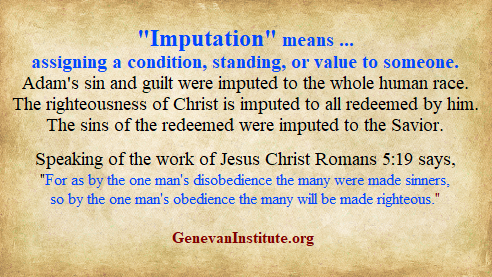
Adam represented all humans when he was put to the test and sinned in Eden. Jesus Christ represented all those God promised to redeem. He suffered and died in their place, taking on their guilt to pay the penalty for their sins. He lived a righteous life in their place, to clothe them with a righteousness that was his own.

The next section in Romans 5, verses 15-21, compares these two representatives.

15 But the free gift is not like the offense. For if by the one man’s offense many died, much more the grace of God and the gift by the grace of the one Man, Jesus Christ, abounded to many.
16 And the gift is not like that which came through the one who sinned. For the judgment which came from one offense resulted in condemnation, but the free gift which came from many offenses resulted in justification.
17 For if by the one man’s offense death reigned through the one, much more those who receive abundance of grace and of the gift of righteousness will reign in life through the One, Jesus Christ.)
18 Therefore, as through one man’s offense judgment came to all men, resulting in condemnation, even so through one Man’s righteous act the free gift came to all men, resulting in justification of life.
19 For as by one man’s disobedience many were made sinners, so also by one Man’s obedience many will be made righteous.
20 Moreover the law entered that the offense might abound. But where sin abounded, grace abounded much more,
21 so that as sin reigned in death, even so grace might reign through righteousness to eternal life through Jesus Christ our Lord.

What each representative did was credited to all they represented. In 1 Corinthians 15:45 God’s word calls Jesus the “last Adam”. There is a big difference between Adam and Jesus. The one brought death by sin. The other brought innocence by the work of the Savior.

Notice the things Jesus secured for us as our representative. By his obedience, his great act of righteousness, all redeemed by him receive …
:15 the gift of grace, abounding to many
:16 justification before God for all our sins
:17 abundance of grace, the gift of righteousness, the promise of reigning in life by Christ
:18 justification and life for all those Jesus represented on the Cross
:19 righteousness by the obedience of our Savior
:20 grace abounding
:21 reigning grace through righteousness and the promise of eternal life

All this was earned by Jesus Christ because God promised it in his Covenant.

Representatives only can stand in place of their people when they are rightly appointed. Ambassadors can only represent Kings and countries if they were sent out by the governing authorities. Our Congressmen can only pass laws when elected by the people they represent. Parents can only oversee the lives of their own children. God the Creator appointed Adam to represent those he created. By that eternal determination in the heart of the Trinity, Jesus was appointed to represent his people.

Paul wrote in Ephesians 1:3-6, “Blessed be the God and Father of our Lord Jesus Christ, who has blessed us with every spiritual blessing in the heavenly places in Christ, just as He chose us in Him before the foundation of the world, that we should be holy and without blame before Him in love, having predestined us to adoption as sons by Jesus Christ to Himself, according to the good pleasure of His will, to the praise of the glory of His grace, by which He made us accepted in the Beloved.”

Only our Creator could assign someone to represent the moral guilt of other creatures. It is interesting that some say this clear teaching of Scripture is unfair. They say it is not fair that Adam’s choice and sin made us all sinners. They say, “He did it, not us. We had no choice in the matter.” They refuse to accept God’s word that his sin was credited to us all as his descendants.

However, you don’t hear people complain that it is unfair that Jesus died in the sinner’s place. He did it, not us. We didn’t choose him, until he first makes us able by grace. Our choice of Christ, is because of God’s prior choice of us. As it says in 1 John 4:19, “We love Him because He first loved us.”


This is not just a technical and theological issue.

This is the attitude correction we need so that we can enjoy our daily fellowship with God. It is the foundation for living the way God said we should.

Instead of having to prove ourselves, or impress others to get what we want, we learn to admit that we really need a Savior. By accepting the fact of our inherited guilt in Adam we finally understand evil.

We see that fallen nature in the extremely lawless and wicked. There it seems to make sense. We would be that way too if it was not for God’s restraining mercies. We can understand why we struggle so much with sin. It is why we do what we know we shouldn’t, and neglect all that God says we should be doing. It helps us know what repentance and confession of sin is all about. It is when we fully agree with God about what he says concerning us i his word. It humbles us before our Savior.

Arrogance disappears, and dedicated service to Christ takes its place. Humble concern for others becomes more important that impressing people.

Why did God decree to permit sin to be part of his universe? Why did he put Adam over us knowing what he would do? knowing the consequences? He did it because it was a necessary part of his purpose in creation, to fully reveal his power, his justice, his mercy, and grace. The perfect universe is not one where there was never any sin. It is one where the Creator redeemed his people from the grip of sin to reveal his amazing grace.

By knowing how we relate to the First Adam, and to Jesus the Last Adam, we appreciate God’s boundless love that stands with us even when we do wrong. We see the restoring power of the gospel that transforms lives and assures us that we are his. We know that no matter how bad things get, God’s plan and promises can never fail.

All who come to rest their hope in the Savior alone, have the promise that one day when the final judgment comes, there will be no need for defending ourselves or for arguing our case to convince God to receive us. It will be a humble falling before the Creator admitting our unworthiness. It will be a time to confess how we confidently trust in the all-sufficient work of Jesus, our representative at Calvary. We will stand there clothed in the robe of his righteousness. We will hear him declare us to have his own innocence credited to us.

What a glorious and amazing blessing is ours because of the work of Jesus Christ!


Go out today with the gospel hope in your heart.

You have an answer for why things seem so bad, even though you know that God is King. You bring with you the remedy God provides for re-structuring your family and community. You have real help for your friends and for those you meet. You can help them discover what they were created to be, and how that can be restored in them by the transforming work of the Redeemer.

This is the one real and genuine cause for joyful worship and thankful living. As Paul concluded here in Romans 5:20, ” … where sin abounded, grace abounded much more”

(The Bible quotations in this article are from the New King James Version of the Bible unless otherwise noted.)


Hawking’s Heaven

On May 18, 2011, in Apologetics, by Bob Burridge

What Dr. Hawking has proven in his denial of the after-life and of heaven, is his own inability to conceive of any aspect of human life beyond the mere physical.


Hawking’s Heaven

by Bob Burridge ©2011

In his now famous interview published in The Guardian, Physicist Stephen Hawking makes a rather odd statement for someone of his reputation in the field of science. He said that the idea of heaven and the afterlife is “a fairy story for people afraid of the dark,”

His reasoning is based upon some assumptions which are taken as reliable first principles. He reasons that since the brain deteriorates after death, and since he believes that all we are is a function of our brains, therefore we simply cease to be thinking and conscious beings once we meet our demise.

Of course in the field of science we admit the logical impossibility of proving a negative. It is possible to show the failure of an hypothesis by assuming something to be true, then by demonstrating that if the hypothesis were true, certain contradictions appear. We also admit that in the field of quantum physics the idea of “contradictions” takes on a meaning unlike our common understanding of the term.

What Dr. Hawking has proven is his own inability to conceive of any aspect of human life beyond the mere physical. We gladly concede this, that Dr. Hawking is unable to conceive such a thing. This does not prove that his assumptions are true. It only shows that his is true to his assumptions.

Presuming that we are mere bio-chemical organisms with nothing corresponding to what we call the “soul” or the “spirit nature,” is not an issue which can be taken into the science lab. It is not something we can measure quantitatively and plug into mathematical structures. It is purely an assumption.

Those of us who accept the premise of non-physical aspects of the universe are not all followers of Middle Age’s fears and superstitions. The idea that we humans invented the idea of God or the concept of heaven to hide from our fears of the dark is naive and uninformed.

Dr. Hawking was a bit more careful in his interview with the German publication Der Speigel in 1988. There he explained that recent advances in theoretical physics have ruled out the “something out of nothing” problem which had been a challenge to purely materialistic thinking in the past. He is quote to have said, “… it would not be necessary to appeal to God to decide how the universe began.” … “This doesn’t prove that there is no God, only that God is not necessary.”

Given his presumptions, Dr. Hawking has merely demonstrated that no contradictions to his assumptions have arisen which are measurable or testable by physical means. To arrive at that conclusion the investigator must close his eyes to the origin of his assumptions. Perhaps while accusing others of inventing ideas for fear of the dark, Dr. Hawking has invented his own structures out of a fear that there is a God to whom he and the rest of us must answer.

Given the presumed universe of this celebrated and admittedly gifted physicist, there is no need for God, and no provable state corresponding to what is called “heaven”. To be scientifically accurate, this does not prove there is no God because that was the starting assumption. It does not prove that there is no after-life or heaven. It just shows that such things do not stand well upon the foundation of these materialistic assumptions.

If Dr. Hawking’s assumptions are not true, then his entire reasoning falls into a pit with a more tenacious grip than the classic concept of black holes in the physical universe. There are no virtual particle pairs dividing and radiating evidences of the energy well that generated them. The theories that rule things out on the basis of a deficit ability to conceive of something else, will cease to exist except in the memories of those who once read about them.

One day Dr. Hawking will stand before the Creator he has not only doubted but also denied. He will discover that darkness is not the greatest terror. He will discover that assumptions that come from the imaginations of human minds are a shifting sand upon which we build doomed buildings. He will see that fundamental truth comes into our experience from outside of us, from the one who made all things, and who gifted Dr. Hawking with his amazing abilities and tenacity.

Tagged with:
 

The Duty of the Gospel

On May 16, 2011, in Bible Studies, Reformed Theology, Romans, by Bob Burridge

Romans 1:16, “For I am not ashamed of the gospel of Christ, for it is the power of God to salvation for everyone who believes, for the Jew first and also for the Greek.”


The Duty of the Gospel

Studies In Paul’s Letter to the Romans
by Bob Burridge ©2011

Lesson 5: Romans 1:13-17

Some people love to give advice. Someone in a group mentions that he has a head ache or a stomach ache, then the suggestions and remedies begin. Each person has a strongly recommended cure. You might casually mention that you need to pick a vacation spot. Before long everyone is a travel agent. They all want you to go to some special place. Or when you say you are thinking about buying a car it’s not uncommon to hear story after story of car buying horrors or personal testimonials of favorite cars to own. This is the way we often learn and get information. The things our trusted friends have found helpful are much appreciated.

When a person brings up things relating to God’s law and justice, of things relating to his soul, he speaks of far greater matters than relief of a headache, where to go on vacation, or buying a car. Most headaches go away, bad vacation choices often give us great stories to tell. Even buying a lemon of a car is something we can survive. But the needs of the soul are eternal, far more important than these other matters.

It’s strange that believers often feel conflicted to help others with important spiritual advice. Few hesitate to advise about taking aspirin, buying a Saturn, or taking a trip to Bush Gardens, but to tell someone at work they need Christ’s forgiveness, to tell a family member they will not find peace outside of living by God’s ways, or suggesting to a neighbor to honor the Sabbath day as God commandment, these issues are seen as bing much harder to bring up.

There should be something in the soul of a true believer in Christ that presses on his conscience to let others know about the gospel that has meant so much to him, a gospel that not only gives eternal life, but also satisfies his deepest needs, and enables him to live in a way pleasing to God.

Sadly, believers often hesitate to speak out for the gospel of Christ. We are all well aware of how such messages are often received. Strange cults have given religious advice a bad reputation. The current morality condemns and scoffs at anyone who believes in absolutes and truth. The real message of the gospel humbles a person and points out his need. Today, people have come to religiously believe that man’s soul has no real problem, that he’s fully able to help himself without God. Many who say they trust in the finished work of Christ are not confident that God can make his plan work without our help.

Modern prejudice has put an anxiety in people’s hearts. They may really want to help,but they don’t want to alienate friends, build barriers, or drive them somewhere else. This presents a great temptation not to say anything, or to modify the message making it more acceptable to the fallen heart.

Paul faced attacks and rejection when he presented the gospel of God. He was shouted at, ridiculed, exiled from cities, beaten, stoned almost to death, accused of imagined crimes, arrested on false charges, jailed, and eventually executed. But until death itself silenced him, he kept on presenting that life changing message. Here in Romans 1:13-17 we see a glimpse of what helped him overcome his anxieties. Paul offers some principles as remedies to help us faithfully represent Christ to a lost world.


A person growing in Christ is compelled to testify about the gospel.

Paul had a great desire that could not just let the issue drop. In Romans 1:13 he said, “Now I do not want you to be unaware, brethren, that I often planned to come to you (but was hindered until now), that I might have some fruit among you also, just as among the other Gentiles.”

In verse 15 of the same chapter he wrote, “So, as much as is in me, I am ready to preach the gospel to you who are in Rome also.”

In our study of verses 8-12 we saw Paul’s strong desire to fellowship with the believers in Rome. He wanted to care for them, and to enjoy their fellowship and encouragement for himself. But there was work to be done in many other places in the world also. So God, in his providence, had not yet provided for Paul to go to Rome.

Yet, in spite of all the threats, dangers and personal sacrifices involved, something inside him kept pressing on his heart to teach those at Rome about God’s message of grace in the Messiah. He did the only thing he could do considering the circumstances. He took time to write this very well planned and organized letter to Rome summarizing the message of the Gospel.

Where did Paul find that power that overcame the threats of his enemies? that so willingly accepted challenging inconveniences? What was it that made him willing to risk even his friendships which he had in his career as a respected Rabbi?

It came from a life transforming work on his soul, the very fruit of the Gospel itself. No one can be a witness for Christ by the mere words they speak. They must be personal recipients of God’s saving Grace themselves. He puts life into us which can be seen by others. He produces a change in us.

Paul wrote to the believers in Ephesus in Ephesians 2:5 where he said, “even when we were dead in trespasses, made us alive together with Christ (by grace you have been saved)”

Our new life in Christ shows through us as a testimony to the power of God, not to our own power. Ephesians 2:8-10 tells us, “For by grace you have been saved through faith, and that not of yourselves; it is the gift of God, not of works, lest anyone should boast. For we are His workmanship, created in Christ Jesus for good works, which God prepared beforehand that we should walk in them.”

If we are redeemed, the inner change ought to compel us to tell others about God’s nature and promises. In 1 Thessalonians 1:7-8 Paul wrote, “so that you became examples to all in Macedonia and Achaia who believe. For from you the word of the Lord has sounded forth, not only in Macedonia and Achaia, but also in every place. Your faith toward God has gone out, so that we do not need to say anything.”

Paul also put it clearly in his letter to the believers in Corinth. In 1 Corinthians 9:16 he wrote, “For if I preach the gospel, I have nothing to boast of, for necessity is laid upon me; yes, woe is me if I do not preach the gospel!”

Peter and John were often persecuted for their message. They were threatened, jailed, and beaten. When told by men to silence the message, they explained the same inner conviction in Acts 4:19-20, “But Peter and John answered and said to them, ‘Whether it is right in the sight of God to listen to you more than to God, you judge. For we cannot but speak the things which we have seen and heard.’ ”

There is no reason for shame in the gospel. In Romans 1:16 Paul wrote, “For I am not ashamed of the gospel of Christ, for it is the power of God to salvation for everyone who believes, for the Jew first and also for the Greek.”

There is nothing about which to be shy. Its message really helps people. Your personal remedy for a headache may not work for everyone. Your dream car may turn out to be a nightmare to someone else. But God’s remedy for the soul in Christ has no defects when it is presented honestly and received with a God-given faith.

Of course you know that the un-redeemed soul will not see it that way. Is that why you hesitate to tell others? In Paul’s time the promoters of the many Roman gods saw Christianity’s belief in just one God as atheism. The Jews saw Paul as one who was bringing in gentile culture and subverting their traditions. Together they ridiculed, and persecuted the Apostle.

Considering all that, when warned of his arrest in Jerusalem, Paul said, “… For I am ready not only to be bound, but also to die at Jerusalem for the name of the Lord Jesus.” (Acts 21:13)

He boldly entered Athens where he faced the philosophers alone. He went to Jerusalem where he was arrested, just as had been foretold to him. Later he came to Rome as a prisoner to face trial in the courts of the Empire. In each case he stood as a clear spokesman for Christ. He could not hold back out of fear from all the intimidation and threats.

Paul understood why those who needed the message of Christ would be opposed to him. God explained it in many places in Scripture and Paul summarized the problem in his First Letter to the Corinthians. In 1 Corinthians 1:23 he said, “but we preach Christ crucified, to the Jews a stumbling block and to the Greeks foolishness.” Then in 1 Corinthians 2:14 he explained, “But the natural man does not receive the things of the Spirit of God, for they are foolishness to him; nor can he know them, because they are spiritually discerned.”

We should not let the unbeliever’s wrong assessment of his own need silence us. Paul encouraged young Timothy saying, “Therefore do not be ashamed of the testimony of our Lord, nor of me His prisoner, but share with me in the sufferings for the gospel according to the power of God” (2 Timothy 1:80). In verse 12 of the same chapter he explained his own confidence which overcame his intimidation, “For this reason I also suffer these things; nevertheless I am not ashamed, for I know whom I have believed and am persuaded that He is able to keep what I have committed to Him until that Day.” (2 Timothy 1:12).

No religion is as offensive to the pride of man and stirs his anger as much as the true gospel. Instead of telling men they are basically OK, it tells them they are in eternal danger and have offended the eternal God beyond any hope of repair. It calls them to admit their own inability and rest in God’s Savior alone. Fallen man hates to admit to things like that.

Don’t let that keep you from telling God’s truth. There is a strong temptation to hide parts of God’s truth, or to make up messages more appealing to lost hearts than the true one.

Transformed people will love the plain, unvarnished truth of God. To those who are made alive in Christ, the gospel is a wonderful message. However, it begins with a sobering truth that must not be hidden. We dare not sugar coat it with a deceptive lie to tell the unbeliever.

We twist God’s word if we say, “God loves you and has a wonderful plan for your life.” Eternity in the fires of hell? Is that the wonderful plan? Yet it God’s plan for many fallen humans. It is where we all deserve to spend eternity according to God’s word. That’s where the masses of humanity will end up. Only those who are washed in the blood of Christ are rescued from that.

Now that’s a hard doctrine! It may cause you to not speak out, or to change it. God forbid that we should be ashamed of the real good news, the truth of God.

Dr. Haldane observed, “The more the Gospel is corrupted, the more its peculiar features are obscured by error, the less do we observe of the shame it is calculated to produce. It is in fact the fear of opposition and contempt that often leads to the corruption of the Gospel.”

God’s truth will always be despised by the unregenerate. It challenges that most loved myth of man’s independence and his imagined ability to determine his own path. It shakes up his security and brings him face to face with the Almighty and Holy God he has offended.

Jesus said, “For whoever is ashamed of Me and My words in this adulterous and sinful generation, of him the Son of Man also will be ashamed when He comes in the glory of His Father with the holy angels.” (Mark 8:38)

Therefore to overcome your shame in the gospel it must first have its powerful work in you. It is the Gospel alone that transforms and produces that compelling desire that is greater than our own self-comforts and defenses. Once you are his, the most important way to become a better representative for Christ is to better know Christ yourself. When the gospel grows in you, it will compel you to testify eagerly about the gospel.

(The Bible quotations in this lesson are from the New King James Version of the Bible unless otherwise noted.)
Back to the Index of Studies In Paul’s Letter to the Romans

Tagged with:
 

Special From the Start

On May 13, 2011, in Reformed Theology, Shorter Chatechism, by Bob Burridge

As the wise and Sovereign king, under no obligation to preserve any of the human race, God promised to redeem some from the fallen race to be his people, and for him to be their God.


Special From the Start

Westminster Shorter Catechism Q:12
by Bob Burridge ©2011

It’s no wonder that so many people complain about depression. They are surrounded by so called “experts” telling them they are just an evolutionary accident. To make it worse, some say we humans are the bad accident that is destroying the rest of the world.

If we are just a cosmic curiosity that emerged by pure chance without purpose or meaning, then our immediate feelings and pleasures would be all that counts.

When people think they are just another animal let loose in a meaningless world to serve themselves, it is understandable that there is so much selfish violence when someone gets in the way. There could be no standard of morality that makes some things just plain wrong. There would be little to get excited about beyond what brings personal pleasure. The malignancy that grows from that is the life-numbing apathy that is so common today.

In such a world, there can be no accountability beyond what immediate benefits the individual. That makes people want others to do the hard work of managing their responsibilities. That idea is being promoted in our culture. It permeates education, some music, movies, games, economics, politics, social theory, personal relationships, and much of current trends in theology.

According to Atheist Jacques Monod, “… man at last knows that he is alone in the universe’s unfeeling immensity, out of which he emerged only by chance. His destiny is nowhere spelled out, nor is his duty. The kingdom above or the darkness below: it is for him to choose.”

Albert Einstein may have been a good physicist, but he studied a universe he misunderstood. He proved that even great intellects can miss the obvious. He once said, “I consider ethics to be an exclusively human concern without any superhuman authority behind it.”

This is what is believed by most of those who report what we think of as news, who make our movies, who write our magazines, construct video games, and make our music.


Humans are not just one little insignificant piece
in a vast evolving universe.

We are not just equal members of a created array of living things. The Bible tells us that we were created to be special agents for promoting the Creator’s glory. We humans are here in God’s world for a reason – each one of us.

Even before humanity fell into sin through Adam, God revealed something amazing. There is a covenant relationship between us and our Creator. It is important that we understand what we were made to be from the beginning, and what Jesus Christ restores us to be when he redeems us to be his people.

The 12th question of our Shorter Catechism teaches about how special humans are. It asks, “What special act of providence did God exercise towards man, in the estate wherein he was created?”

The answer it gives is very simple — but profound, “When God had created man, he entered into a covenant of life with him, upon condition of perfect obedience forbidding him to eat of the tree of knowledge of good and evil, upon pain of death.”


A covenant is a very special type of promise.

The Bible talks a lot about covenants, but this i’s a foreign idea in our 21st century culture. It is not like the contracts and agreements we make between two equals parties.

The Old Testament in Hebrew uses the word berit (ברית) to describe these covenants. It was a common word back when God moved Moses to use it in his books of the Bible. It was a term used in the ancient Hittite suzerainty treaties of that day.

There were basic elements in every covenant. When a king conquered a city or province, he was thought to have the right to kill all his enemies. Instead of just destroying all the people, the wise king often subjugated them. It was not a negotiated deal he worked out with representatives of the conquered citizens. He sovereignly imposed a covenant making promises based upon conditions.

The King promised he would not kill them even though he had a right to do so. He also promised that his army would protect them. The people had to pledge loyalty to the king, and do all that the king commanded. Usually that meant serving in his military, and paying taxes. The penalty for violating the treaty was death. There was a formal ratification ceremony to legalize the deal. Animals were dismembered to show what would happen to violators of the covenant.

After explaining all this from historical records, Dr. O. Palmer Robertson, in his book The Christ of the Covenants, defined these ancient covenants as, “a bond in blood sovereignly administered.”

God used this same word to explain his special providence toward the humans he created. The bond God made with man is referred to in the Bible as a berit (ברית), a covenant. As the Sovereign Creator, before the fall into sin, God promised life to Adam. He would protect and sustain him and all the humans he represented. They were obligated to loyally obey God, and to served him as caretakers of his creation.

We know that there was that tree in Eden called the tree of the knowledge of good and evil. It was there to test their obedience. The tree of life represented God’s promise to them. However, man’s duties were more broad than just not eating from the forbidden fruit. There were several Creation Ordinances God gave to Adam.

In Genesis 1:26-28, the Bible tells about the creation of man. “Then God said, ‘Let Us make man in Our image, according to Our likeness; let them have dominion over the fish of the sea, over the birds of the air, and over the cattle, over all the earth and over every creeping thing that creeps on the earth.’ So God created man in His own image; in the image of God He created him; male and female He created them. Then God blessed them, and God said to them, ‘Be fruitful and multiply; fill the earth and subdue it; have dominion over the fish of the sea, over the birds of the air, and over every living thing that moves on the earth.’ ”

Humans were made to honor and to be loyal to their Creator as their only God. They were to work in the garden to maintain it and exercise dominion over it. They acted in God’s place as representative masters over all that was made.

Adam and his wife were to produce offspring to fill the earth. In chapter 2, Genesis adds that they were to be faithful to one another.

When he finished his creation, God limited man’s work in a very special way. He was to work faithfully for six days, then set aside one full day of ceasing from that labor. That wasn’t Adam’s day to take it easy and rest up. It was a day dedicated to the Lord. The rest it speaks of is a ceasing from the labor he performed on other days to provide for his own needs. This would be a day for honoring the Creator in his ceasing from the works of Creation. Man’s work on that day was to worship their Maker very specially.

In Exodus 20:8-11 God said the Sabbath Commandment was based upon this creation ordinance. There it says, “Remember the Sabbath day, to keep it holy. Six days you shall labor and do all your work, but the seventh day is the Sabbath of the LORD your God. In it you shall do no work: you, nor your son, nor your daughter, nor your male servant, nor your female servant, nor your cattle, nor your stranger who is within your gates. For in six days the LORD made the heavens and the earth, the sea, and all that is in them, and rested the seventh day. Therefore the LORD blessed the Sabbath day and hallowed it.”

The Sabbath wasn’t something new instituted at Mt. Sinai for Israel. It was a day to remember the Creation Command God announced at the beginning. There was to be a day of ceasing from what was done on the other six days.

This Covenant of Life was a gracious covenant because it was totally undeserved. Adam was newly created. He hadn’t done anything to deserve God’s blessings. The idea that grace and law are at odds with one another is a horrible misunderstanding. Law and Grace are not opposites. They must go together. Law informs us about what honors God. It reveals our sin when we disobey it. Grace removes our guilt, and enables us to do what honors God by his redeeming love.

Since the promise was life, the Westminster Shorter Catechism calls it a Covenant of Life. Some call it the Covenant of Works because of the condition of obedience placed upon Adam. It has been suggested that we should call it the Covenant of Creation.

These Creation Ordinances were later summarized in the Ten Commandments. They were each assumed to continue by Jesus and the Apostles. By the power and love of our Risen Savior we are forgiven and redeemed to keep them today. God demanded perfect and personal obedience to all these basic ordinances. There is no provision for only sometimes being faithful to God. No one is able to obey that perfectly. It is only when we are clothed in the righteousness of our Savior that we are counted as worthy to stand in the presence of the Creator we have offended.

As long as the humans fully obeyed the covenant instituted at Creation, God gave them life. If they disobeyed, even in one small forbidden act, that life would be taken away. They would be subject to physical death, and would die spiritually. The result is total alienation from God for themselves and for all those who would descend from them.


God’s Covenant in Eden was what we call a Federal relationship.

Adam represented all the human race. We were all there, represented by him. The Creation Covenant, all it’s commandments together with the blessings and punishments, were made through Adam, but with all of us federally. As Paul put it in Romans 5:12, “Therefore, just as through one man sin entered the world, and death through sin, and thus death spread to all men, because all sinned.”

Adam’s first sin violated the covenant and made all he represented subject to death. In him we’re all fallen and deserve God’s wrath forever.

As the wise and Sovereign king, under no obligation to preserve any of the human race, God promised to redeem some from the fallen race to be his people, and for him to be their God.

This is what we call the Covenant of Grace. (We’ll take that up on more detail in a later study.) It is also referred to as a berit (ברית), a covenant, in the Bible. It was not deserved by us. It was sovereignly made with us at the cost of the shedding of the Savior’s blood.

Jesus the Messiah was the only one qualified to represent the fallen race other than Adam. Federally, as the representative of his people, the Savior died in their place.

The principle of federalism means that representatives act for those they represent. When our lawmakers pass a law, we all have to obey it. When congress declares war, we are all at war. if it is our personal choice or not. God tells us that Adam represented the whole human race. He also tells us that Jesus represented all of his people when he died and rose again.

It is interesting that people often object that it is unfair that we all fell in Adam. The fallen soul wants to be captain of its own fate. It rejects the biblical definition of God. It rebels at the idea that he has to pay for what Adam did.

The Creator built this principle into his creation. What he directly decrees cannot be wrong. He is the definition of what is right and wrong in the universe he made for his own purposes and glory. It is interesting that very few ever complain that it is unfair to be represented by Jesus. They don’t like it that we are all condemned by what Adam did, but few say it is not right to be redeemed by Jesus when he represented us on the Cross. He obeyed God’s law and died representing his people in the same type of federal relationship.


The key idea in this first covenant with man is the promise of life.

That is what God promised. In the end, that life is exactly what all his people will receive.

The path to that wonderful end is the adventure of human history. It is the continuing war between evil and good. It includes the attacks and calamities that come against us which are the fruits of that fall into sin. It is the victories God’s people enjoy when suffering is comforted, when disease is healed, when lonely people find love, when families are blessed with children, when lost hurting souls are redeemed by Christ, when humble believers gather together in humble worship, and when those rescued souls enjoy the beauty and wonder of the Creator’s Universe.

God’s Creation Covenant did not fail. It accomplished exactly all God intended it to. It set up the need that revealed his saving grace. It also shows that God made us special and that is what we ought to be. Those redeemed are to carry out the responsibilities he gave to Adam and to his posterity.

Enabled by the work of our Living Savior, Jesus Christ, the one who shed his blood in our place, we should be faithful managers of all God made. We are to use all God made for the Creator’s glory. We are to use it responsibly for our provisions. We should be faithful in our marriages, and in the raising of our children. We are to be hard workers doing our best in all we do, and doing it first of all for God’s glory. We should honor God’s Sabbath according to the rules he gave us in his word. We need to remain loyal to the one true God only, the one who made us.

The promises are still to be realized in full. One day, perhaps soon, maybe a long time in the distant future, the death imposed by Adam’s sin will be no more. We will enter an eternal and perfect place in the presence of our Maker. There he will sustain us in life, and we will joyfully and perfectly live for his glory. Forever he will be our God, and we who come through Christ will always be his people.

There will be no more tests, no more struggles or discomforts, no more war with evil, and no more waiting for victory to come some day. That day will come. It is at the end of the path we all struggle along every day. When we know the path, and the power and grace of the one who constructed it, we can enjoy the wait, find comfort even in the hard stretches of the journey.

(The Bible quotations in this lesson are from the New King James Version of the Bible unless otherwise noted.)


Encouraged Together

On May 9, 2011, in Bible Studies, Romans, by Bob Burridge

Paul longed for a time of fellowship with the believers in Rome so he could encourage them, and be encouraged by them.


Encouraged Together

Studies In Paul’s Letter to the Romans
by Bob Burridge ©2011

Lesson 04: Romans 1:8-12

People were not created to be alone. We were created to be families and communities. We were created to work together to produce the things we need. We were commanded to organize into churches, and into governed societies. This can get frustrating at times. These groupings are as imperfect as the individuals that form them.

There are wrong ways of dealing with imperfect groups of people. Some people just withdraw and isolate themselves when they have a hard time with the behaviors of others. They might tolerate working with others in limited ways out of necessity, but they try not to develop close relationships. They may even attend worship, but limit their contacts with the others in the church beyond that.

Others keep jumping from group to group looking for a more perfect situation. They have little commitment to their workplace, community, and sometimes even to their family relationships. They often drift from job to job. They may even move from community to community. They are the ones who never find a church they like. To justify their lack of commitment they list all the faults and imperfections of those who make up or who lead the group.

This is not the way God taught us to live. If there are problems we need to become part of the solution. Loyalty and commitment are important character traits. We ought to develop them. The fallen world has abandoned those values in favor of a more self-serving ethic. Today loyalty and commitment ends when the going gets hard.

Marriages end for reasons not justified by God’s law. People leave their spiritual families in churches as easily as they leave their spouses. It’s hard for employers to afford new workers when they leave as soon as opportunity comes along, even after considerable expense has been made to train them.

Instead of abandoning others when problems arise, and in place of that critical spirit of finding faults, there ought to be mutual encouragement of one another in Jesus Christ. There is great joy in seeing God at work in families, churches, workplaces, and communities.


Paul appreciated the Roman church’s
great reputation which was spoken of world-wide.

Romans 1:8, “First, I thank my God through Jesus Christ for you all, that your faith is spoken of throughout the whole world.”

The faith God had put into the hearts of the Roman believers was testifying powerfully. It provided a real-life demonstration that the gospel is God’s truth, it works!

In our study so far (Romans 1:1-7) we have seen that the gospel means “good news”. All humans are separated from God’s fellowship because of the offense of real moral guilt. Not just individual guilt, but primarily the guilt and corruption we inherit from Adam. But God made a promise in Eden after the first sin. One would come who would be born of a woman, who would suffer in place of God’s people and crush Satan.

As history unfolded more details were made known. By the time of the Apostle Paul, it had become clear that Jesus was that Promised One.

The good news that there are fallen humans who are reconciled with God through Jesus Christ had come to Rome too. The hearts of believers there had been changed by the power of God. Faith had been implanted along with life-transforming power. Good News indeed!

The watching world had seen the changes in the lives of the Roman believers. Paul calls believers “epistles.” In them, the world could see the effects of the gospel. In 2 Corinthians 3:2-3 Paul wrote, “You are our epistle written in our hearts, known and read by all men; clearly you are an epistle of Christ, ministered by us, written not with ink but by the Spirit of the living God, not on tablets of stone but on tablets of flesh, that is, of the heart.”

Similarly Paul said to the believers in Thessalonica in 1 Thessalonians 1:7-8, “… you became examples to all in Macedonia and Achaia who believe. For from you the word of the Lord has sounded forth, not only in Macedonia and Achaia, but also in every place. Your faith toward God has gone out, so that we do not need to say anything.”

We should all be concerned to show the work of Christ in our lives. Others, both in the church and outside of it, will observe our words and actions. God’s truth and grace in Christ ought to be evident in us. Jesus said our lives should shine like light so that men might see our good works and glorify our Father in heaven (Matthew 5:16).

The believers in Rome, were imperfect (we will see more of that as we continue), yet they were being a good testimony to the world of Christ’s life-transforming power.


Paul explained that he was in continual prayer
to praise God for what he had seen in them.

Romans 1:9, “For God is my witness, whom I serve with my spirit in the gospel of His Son, that without ceasing I make mention of you always in my prayers,”

Similarly, when John saw other believers living as evidence of Christ’s power, he rejoiced. He wrote to them saying, “I rejoiced greatly that I have found some of your children walking in truth, as we received commandment from the Father.” (2 john 1:4), and “For I rejoiced greatly when brethren came and testified of the truth that is in you, just as you walk in the truth.” (3 John 1:30).

Man’s fallen nature tends to become jealous about the success of others. However, we should not be just individuals trying to get gain for ourselves. We ought to learn to rejoice in the success of others. Specially others in the body of Christ. We are a family together with them. There should be evidence of certain family traits in each of us. The fruit of the Holy Spirit and our spiritual loyalty ought to mark us out.

There is a fundamental unity that we ought not ignore, even when things are imperfect. 1 Corinthians 1:10 says, “Now I plead with you, brethren, by the name of our Lord Jesus Christ, that you all speak the same thing, and that there be no divisions among you, but that you be perfectly joined together in the same mind and in the same judgment.”

There are also some limits placed upon our fellowship. There ought to be some kind of division that separate us from those who have no loyalty to Christ and to his church. There should be no confusion about who is a representative of Christ, and who is not. A compromising testimony by the church does not honor God. It confuses his message and obscures the gospel.

In that same letter to the Corinthians Paul wrote 1 Corinthians 5:9-13, “I wrote to you in my epistle not to keep company with sexually immoral people. Yet I certainly did not mean with the sexually immoral people of this world, or with the covetous, or extortioners, or idolaters, since then you would need to go out of the world. But now I have written to you not to keep company with anyone named a brother, who is sexually immoral, or covetous, or an idolater, or a reviler, or a drunkard, or an extortioner — not even to eat with such a person. For what have I to do with judging those also who are outside? Do you not judge those who are inside? But those who are outside God judges. Therefore ‘put away from yourselves the evil person.’ ”

From the larger context we see that this is not about shunning those who sin. We would have no one left in our lives if we did that, since we are all sinners by God’s definition of it. The context is in the membership of the church. Those who continue to rebel against God’s standards unrepentantly should not be on the roll as members of God’s family. They are not rightly part of our spiritual family’s meals and trust. Out of respect for the standards God demands of his church, such people need to be put out of the church as long as they insist on defending their rebellious behaviors and attitudes. But we are not to be unkind to them. We are told to treat them as unbelievers and work to bring them to humble repentance and restoration to fellowship through the power of the gospel.

In his second letter to the church at Corinth Paul wrote in 2 Corinthians 6:14-17, “Do not be unequally yoked together with unbelievers. For what fellowship has righteousness with lawlessness? And what communion has light with darkness? And what accord has Christ with Belial? Or what part has a believer with an unbeliever? And what agreement has the temple of God with idols? For you are the temple of the living God. As God has said: ‘I will dwell in them And walk among them. I will be their God, And they shall be My people.’ Therefore ‘Come out from among them And be separate, says the Lord. Do not touch what is unclean, And I will receive you.’ ”

When the church stands together, marked by loyalty, it presents a powerful testimony to the world. The goodness of God’s news is made plain by the transformation of lost souls woven together into a family of God.

We should set aside time in our prayers to praise God for his blessings upon his people. Paul’s prayer reminds us again of the wonders of Grace. Paul does not commend the Romans as if God had them to thank for the good testimony of the church. He thanks God for their obedience of faith. God is the one who works goodness in us. Nothing remains in which we can boast. There is no place for self-pride. Instead, we have a marvelous sense of God’s redeeming and sanctifying grace.


Paul had a compelling desire to be encouraged
together with the Roman believers.

Romans 1:10-12, “making request if, by some means, now at last I may find a way in the will of God to come to you. For I long to see you, that I may impart to you some spiritual gift, so that you may be established — that is, that I may be encouraged together with you by the mutual faith both of you and me.”

Paul very much wanted to go to Rome to see these believers in person. However, God had not provided the opportunity. When we study verse 13 we will see how Paul, though wanting to come to them, kept his own desires in submission to God and his greater and often hidden plan.

The Apostle’s purpose in wanting to go to Rome had two parts. On the one hand he wanted to build them up by imparting spiritual gifts to them. Some of that work was special to the office of Apostle. There were unique miraculous gifts in that Apostolic era for the building of the church’s foundation.

Some of the gifts to be imparted were a common work we all do as believers. By our fellowship we are to stir one another to spiritual growth. We help one another develop the fruit of the Spirit. We become mutual examples of love, joy, peace, patience, kindness, goodness, faithfulness, gentleness, and self-control. (see Galatians 5:22-23). In humility we correct one another when we fall into sin or into neglect of these fruits.

On the other hand Paul longed for himself to be encouraged by the believers in Rome too. Ministers and members of the church alike are important to one another in Christ.

The union we have as a church is very special. Our bond is not just because we have common interests, or like temperaments, or similar backgrounds and circumstances in our lives, or even plans for the future. Those may occur among us but our bond is much stronger than that. It is not just because we have common beliefs and convictions.

These are the things that cause union in the world too. But in the family of God there is an element the world cannot know. The special nature of our fellowship consists in our real spiritual union in Christ. We have an actual family bond. We have the same Father in heaven. We are joint heirs of eternal blessings in Christ. We are truly brothers and sisters spiritually.

In John 15:5 Jesus used a helpful analogy. He said, “I am the vine, you are the branches. He who abides in Me, and I in him, bears much fruit; for without Me you can do nothing.”

We all draw from the same nourishment. The same sap flows through us. Our spiritual life blood is the same. We share in the same covenant benefits, live by the same rules, and are one with the same Lord. 1 Corinthians 6:17 says,”But he who is joined to the Lord is one spirit with Him.”

Paul wrote important instructions to the church in Ephesus. In Ephesians 4:2-6 he said, “with all lowliness and gentleness, with longsuffering, bearing with one another in love, endeavoring to keep the unity of the Spirit in the bond of peace. There is one body and one Spirit, just as you were called in one hope of your calling; one Lord, one faith, one baptism; one God and Father of all, who is above all, and through all, and in you all.”

Though we have this unity, we are not all the same. Not by far. There is a diversity of gifts in the body of Christ. We are all very different from one another: We are born in different decades. We dress differently, wear our hair differently (for those who have it), and have different styles of speech. We have different talents and abilities. God has called us to different occupations.

1 Corinthians 12:14-18 explains it so well, “For in fact the body is not one member but many. If the foot should say, “Because I am not a hand, I am not of the body,” is it therefore not of the body? And if the ear should say, “Because I am not an eye, I am not of the body,” is it therefore not of the body? If the whole body were an eye, where would be the hearing? If the whole were hearing, where would be the smelling? But now God has set the members, each one of them, in the body just as He pleased.”

Every member of the body is vital to the whole. Paul adds in verse 22, “No, much rather, those members of the body which seem to be weaker are necessary.” In verses 25-27 he says that we need to value every member of the church, “that there should be no schism in the body, but that the members should have the same care for one another. And if one member suffers, all the members suffer with it; or if one member is honored, all the members rejoice with it. Now you are the body of Christ, and members individually.”

Because one of us has a gift, we all have it too as brothers and sisters in the Lord. We are a family in Christ.

Ever since I was very little, I’ve loved to take things apart. I disassembled radios, television sets, door bells, carburetors, kitchen faucets, and so on. Putting them back together was always harder. I know you have all had the experience in one way or another of putting parts together. It’s a bit unsettling when you have some parts left over. A few times I’ve ha to install new kitchen faucets. I remember once when there was a rubber washer left over. When I turned it on all seemed ok — until I tried the rinsing hose. Water sprayed all over. That little washer was important! Just as every component and wire is important to a radio of computer, so also every one of you is important to the proper functioning of the body of Christ.

What happens when a vital part of the body is missing? even just for a while? Can you imagine what it would be like if your body parts only worked once-in-a-while? What if your eye or a particular finger only was available occasionally? What if a lung shut down unexpectedly every few days? Could you be just as effective if you never knew when you would have to do without an arm or leg for a day? or for a week? Think of what it would be like walking down the street and a foot unexpectedly decided to shut down for a while.

That is why it is important to have regular attendance in the church. When attendance is occasional, it’s like occasional paralysis. Each part contributes to the whole. It could be a little story, or experience in your life, a little personal insight or a lesson you’ve learned, or how you smile at one of the children, or when you show a bit of humility among the adults. These each may seem insignificant to you in casual conversation over refreshments after worship, but maybe that little gesture or comment is exactly what someone else needs to see or hear.

When one person is absent it effects the whole — as when a family member is gone. Of course sometimes God in his providence keeps us away. We may get sick, or may be called out of town, or travel on vacation. Unless we can’t be there by reason of God’s providence, we have a job to do for Christ as part of his family.

Jesus Christ has called each one of us to family union and Kingdom service. Don’t cripple the body by withholding that talent or experience God has entrusted to you. It ought not be a chore to be with God’s people in worship on the Lord’s Day. It ought not to feel as if you are making a sacrifice. Being there instead of home watching TV, or sleeping in, is an important family duty. Getting to bed decently on Saturday night so you can get here on time Sunday morning, ought to be a satisfying preparation for your service to the church, and for fulfilling your part as the whole body comes together to worship the God who saved us.

We each have a joint obligation to devote our gifts to the glory of Christ, and the growth of the body of his church. It is a job for which we need to make preparations. We need to take our Christian responsibilities seriously. Hebrews 10:24 says, “And let us consider one another in order to stir up love and good works.”

Our service together on Sundays, and our support of one another all week long, is not an option or an extra to add to our lives as Christians. It is our reasonable service.

The fallen world around us has a different standard. It makes friends to satisfy self-needs, to gain what friends can offer, or to feel accepted. We have been transformed from that by Christ. Our friendships in the Lord are to honor our Savior and to help one another.

Christ did not call us to be alone. Nor has he called us to neglect our families, jobs, church, or community. They may be very imperfect places. Other families, jobs, churches, or communities may look more appealing to us in some way. However, children don’t leave families and move in down the street with another family because they have a better pool or TV set, because there are more kids to play with, because the allowance is better, or because it’s a shorter walk to the mall. There should be loyalty and commitment to the family. So also there ought to be an undying loyalty to the imperfect unions we have at work, and in our communities. We should not looking for something better, but how to serve where God puts us. Even more so there should be loyalty and a sense of belonging in the church, our spiritual family, the body of Christ. Be an active member lending all you can to the needs of your brothers and sisters in Christ.

The church works best when every part is committed and working hard as a family. Oh, what a testimony that is to the glory of our Heavenly Father when the spiritual family works together, when all its parts are functioning, when everyone is present and on time looking for opportunity instead of looking for gain.

This is what Paul is saying in this part of his introduction to the letter to the Romans. He longed for a time of fellowship with the believers in Rome so he could encourage them, and be encouraged by them.

(The Bible quotations in this lesson are from the New King James Version of the Bible unless otherwise noted.)

Back to the Index of Studies In Paul’s Letter to the Romans

Tagged with:
 

Failure Is Impossible

On May 6, 2011, in Reformed Theology, Shorter Chatechism, by Bob Burridge

Westminster Confession 5:1, “God the great Creator of all things does uphold, direct, dispose, and govern all creatures, actions, and things, from the greatest even to the least, by His most wise and holy providence, according to His infallible foreknowledge, and the free and immutable counsel of His own will, to the praise of the glory of His wisdom, power, justice, goodness, and mercy.”


Failure Is Impossible

Westminster Shorter Catechism Q11: God’s Providence
by Bob Burridge ©2011


When we make plans, we try to plan for the unexpected.

If you go on an camping trip, you take along a first aid kit. You pack tools to repair things. As Boy Scouts we were expected to live up to our motto, “Be Prepared.” That’s why we have spare tires in our cars, back-up files for things stored on our computers, and fire-extinguishers in our kitchens.

None of us can be sure about what might happen, so we prepare for the unknown. Those of us who live in Florida try to be prepared during the warmer months for the threatened approach of a hurricane. A few years ago Tropical Storm Fay appeared to be aiming directly at us here in Pinellas County. Stores sold out of propane tanks, bottles of water, duct tape and batteries. As it turned out, Fay didn’t become a Hurricane, and our county never felt it’s power. However, we wisely prepared, even though we knew the predictions were very uncertain.

Several years ago Hurricane Charlie also seemed to target Tampa Bay. Just hours away, it suddenly turned sharply and hit communities way south of us. Many were unprepared there because it was suppose to visit us. The result was devastating to a community caught by surprise. It is always best to take precautions in spite of our best guesses to err on the side of safety.

We often have to deal with things we don’t count on. We hear people talk about back-up plans, fall-back positions, alternate routes, and things like that.

When our astronauts first landed on the moon, one of the first things they did was to scoop up what they called a “contingency sample” of moon soil. It was gathered in case they had to leave quickly before more careful samples could be collected.

Our plans are good if they do what we design them to do, but they are seldom, if ever, perfect. That is why we plan for the unexpected and make room for the uncertain. This is why it is hard to really comprehend the fact that God’s plan never changes or fails to accomplish exactly what God eternally intended.


It is hard for us to imagine a perfect plan.

God’s eternal plan for his creation includes everything that ever happens, and all that makes it happen. What God intends always takes place just as he meant it to.

Psalm 135:6, “Whatever the LORD pleases He does, In heaven and in earth, In the seas and in all deep places.”

There’s a prejudice in the fallen mind. Unless you are redeemed by grace, you will always modify what God says about himself in the Bible.

One of the hardest concepts to understand, much less accept, is the absolute sovereignty of God. He is not only King of all kings. He is Ruler over every molecule, every quantum of energy, every event, and every outcome.

Bible scholars spent over five years putting together the Westminster Standards. They summarized the decrees of God in Shorter Catechism questions 7 through 12. The answer to question 7 tells what the Bible says about God’s decrees. It says, “The decrees of God are his eternal purpose according to the counsel of his will, whereby, for his own glory, he hath foreordained whatsoever comes to pass.”

God put his decrees into action with the works of creation and providence. He Created everything in the physical universe, and all the living things he put in it. His work of providence is his direction of all creation toward it’s intended goal.

Question 11 of the Shorter Catechism asks, “What are God’s works of providence?” The answer derived from Scripture alone is, “God’s works of providence are his most holy, wise, and powerful preserving and governing all his creatures, and all their actions.”


God is much more than what most people understand.

Even God’s own spiritual children can get confused by popular opinions about their Creator’s nature. Our imperfect human minds try to imagine him being like us. In our imperfect state we tend to read our own limitations into the infinite, eternal, and unchangeable nature of God.

Some believers still imagine God to be limited by what he created as if he needs our permission to save us. The problem is that the Bible says very clearly that you trusted in him only because he already redeemed you. Otherwise we would never have learned to love him.

Some imagine that our prayers actually inform God and convince him to change his eternal plan. That’s not the power promised in prayer. We aren’t smarter than God to advise him. However, God uses the power of our prayers to carry out his perfect plan. When you pray, and God does what you ask him, you discover that all along he made you part of that wonderful work. When you fail to pray, you show that you have not honored God’s call to come to him about the needs he brings to your attention. It shows a lack of care to be part of his works on earth. That is a frightening thing to discover about yourself.

Generally, fallen man accepts his corrupted idea of God. For the most part, he loves believing in a super being who helps him, but he refuses to admit that he answer to him as a fallen sinner. He does not give him all the glory for his faith, for his good choices, for his charity, and successes. He wants some of the glory for himself.

When God’s love transforms your heart through Christ, you set aside your human pride and prejudices. You see a more marvelous God than you otherwise could have imagined.

We already read in Psalm 135:6 that God does all he pleases at all times. Psalm 115:3 says almost the same thing. … our God is in heaven; He does whatever He pleases.

That was one of the lessons Job had to learn. In Job 42:2 he humbly learned to say to God, “I know that You can do everything, And that no purpose of Yours can be withheld from You.”

In Colossians 1:16 the Apostle Paul wrote, “For by Him all things were created that are in heaven and that are on earth, visible and invisible, whether thrones or dominions or principalities or powers. All things were created through Him and for Him.”

That is the purpose of Creation. He made all things “for him”. Creation built the platform on which all God planned is carried out. Everything, without exception, declares the Creator’s glory and power.

The Westminster Confession, chapter five, begins this way, “God the great Creator of all things does uphold, direct, dispose, and govern all creatures, actions, and things, from the greatest even to the least, by His most wise and holy providence, according to His infallible foreknowledge, and the free and immutable counsel of His own will, to the praise of the glory of His wisdom, power, justice, goodness, and mercy.”

This is the work of providence, one of the great truths about your God. It is amazing and comforting to remember that God directs everything in the world in which we live.


God’s providence directs the events of nature.

The word providence comes from a Latin word providere, which means “to see before.” The corresponding Greek word in the New Testament is pronoia (πρόνοια). It means “forethought.” (ISBE)

It’s far more than just looking ahead to see what is going to happen. God knows it, because he decreed it, and because he has the infinite power to control it all. God provides for all that is needed for his plan to work out. He sees it all as a whole thing, not as individual disconnected events. This provision for the whole course of history is what we call his “providence”.

Throughout the Bible, we see God’s absolute control over his creation. In Job 12:15 it says about God, “If He withholds the waters, they dry up; If He sends them out, they overwhelm the earth.”

Jesus said in Matthew 5:45, “… He makes His sun rise on the evil and on the good, and sends rain on the just and on the unjust.”

In Acts 17 Paul described God as the Creator and Preserver of everything. He not only made it all, he also directs everything to serve his purposes. In verse 26 he said about all the nations, that he, “… has determined their preappointed times and the boundaries of their dwellings.”

One of the problems we struggle with is understanding evil. People wonder how God can be in control when there is wickedness in his universe.


But by God’s providence he even governs the boundaries of evil.

If God made all things to declare his glory as the Bible tells us, then there needs to be a way to display his Justice, his Mercy, and his Amazing Grace. So he made his world susceptible to sin so he could rescue his people from it. Obviously, the best universe is one where sin is beaten, not one where sin never existed.

It is not for us to be able to see how it all fits together just yet, but we are assured that it does. Job never knew why God put him through those hard times and deep sorrows, but he did learn that God had reasons he did not need to know.

While Joseph suffered in prison after his brothers sold him into slavery, while he wondered why he was put in a dungeon for a crime he never committed, he could not yet see how God was setting the stage for great blessings through him. He was put in place to save God’s people from a famine. He was there to lead them to Egypt which became the background for the great Exodus.

When he was very old Joseph lived to see some of the reasons for his suffering. He said to his brothers in Genesis 50:20, “But as for you, you meant evil against me; but God meant it for good, in order to bring it about as it is this day, to save many people alive.”

The greatest act of evil in all of history was the brutal killing of Jesus Christ. Evil men were clearly responsible for what they did, yet God had planned it from all eternity as the greatest display of his love and grace. Peter explained it exactly that way to the crowds in Acts 2:23, “Him, being delivered by the determined purpose and foreknowledge of God, you have taken by lawless hands, have crucified, and put to death;”

There was no excuse in saying that God determined it. Those who crucified him were personally guilty. They sinned willingly. Yet it was all part of a greater plan. Probably as they laid our Lord’s body in the tomb and accepted the fact of his death, the disciples could not see how any good could come from that Roman injustice. However, on the third day the resurrected Jesus appeared to them, and they could see there was a wonderful purpose in what seemed a senseless violence.

Proverbs 16:4 says, “The LORD has made all for Himself, Yes, even the wicked for the day of doom.”


As God’s child, your calling is to live honorably,
responsibly, through the unfolding of these decrees.

We who live in Florida know how hard it is to predict path of hurricanes. They are driven by the heat of the sun. It makes the air above the waters in one place hotter than the air around it. The rising hot air draws in the cooler air which gets heated up and rises into the atmosphere. The wind rushing in starts to spin because of the rotation of the earth. Other air masses around the storms feed it, and push at it, and sometimes become barriers to its movement. The storm follows the path through the boundaries of the surrounding systems. Though it is complicated, and we have a hard time predicting exactly where a storm will go, it moves as part of a greater complexity.

The path of history seems to move through the boundaries of circumstances, ambition, opportunity, greed and patriotism. Severe storms in the North Atlantic, navigational mistakes, and a new set of British naval tactics ended the powerful military threat of the Spanish Armada. The great Empire of Rome faded away under incompetent Emperors, self-centered citizens, a weakened military unable to protect from invaders, and as the historian Gibbon calls it “immoderate greatness.”

The brave patriotism of oppressed colonies stood with unexpected resolve against England. The many loyalties and events of the Revolutionary War gave us our own nation.

All the turns in the path of time were long before laid out in the plan of God. He sent the winds against mighty warships, and stirred bravery in the hearts of patriots. He trained and gave brilliance to leaders, inventors, pastors, explorers and writers. He raised up nations and brought down empires.

In your own life He caused you to be conceived just as you are in the womb of your mother. He gave you the lessons, joys, tragedies, and opportunities that shaped your choices. He alone opened your eyes to see your need for forgiveness for offenses against God, and stirred faith in your heart to trust in Jesus Christ as your only hope and Savior.

He brought you here at this very page, at this very moment, with all that is now on your mind, with all you remember of your life before this lesson started, and with all your concerns about what you face when this lesson ends. He has used all that has touched your life and all the lives you’ve touched to create the opportunities that shape the rest of today, tomorrow, and the remainder of your life.

Though it is valuable and important to know the history of what God has done, and to understand the principles that he lovingly tells you about in his word, the moral question is not how or why things are as they are right now. It is to know how you will live in these conditions to be a good child of your Father in Heaven.

Deuteronomy 29:29 says, “The secret things belong to the LORD our God, but those things which are revealed belong to us and to our children forever, that we may do all the words of this law.”

Your responsibility is not to try to figure out what is coming next, or why God decrees each thing. It is to do what he tells you to do with the attitude he says is right.

Give thanks to God alone for every good thing in your life. James 1:17 reminds us, “Every good gift and every perfect gift is from above, and comes down from the Father of lights, with whom there is no variation or shadow of turning.”

Rest in the power of the Risen Christ alone for whatever strength you will ever need. His word gives you lessons that make you wiser than anyone will ever become in universities, through years of experience, research, and practice. Nothing, no enemy, no rude or ambitions rival, no turn of circumstances, can even slightly frustrate the plan of the Creator and Preserver of the Universe, the one who is your loving and faithful Redeemer, Enabler, and Father.

Confidently press on in service of the King of kings. Remember that the little things you do, your choices, your hardships and sufferings, the words you speak, the thoughts you think, even your humbling failures are part of something far bigger than any of us can imagine.

God’s providence isn’t an intellectual exercise in theology. It is the promise and hope of every believer in Christ. It is the assurance that you have nothing to fear.

As the Apostle Paul was moved to write for God in Romans 8:28, it is the certainty that, “all things work together for good, to those who love God and who are called according to his purpose.”

(The Bible quotations in this lesson are from the New King James Version of the Bible unless otherwise noted.)

Tagged with:
 

An Ancient Promise Fulfilled

On May 2, 2011, in Bible Studies, Reformed Theology, Romans, by Bob Burridge

When we see all the bad news closing in around us, or even when we become the victims of a world plunged into rebellion against its Creator, God does not give us pain killers, he gives us a cure. He does not just make us feel better, he cures us of the sickness itself. God doesn’t ask us to just convince ourselves we are right, he reveals what is right and true.


An Ancient Promise Fulfilled

Studies In Paul’s Letter to the Romans
by Bob Burridge ©2011

Lesson 03: Romans 1:2-7

We hear bad news every day. There are accidents, disasters, diseases, crime, children shooting children, doctors killing the unborn, storms devastating communities, epidemics, resistant strains of bacteria threatening our health, and violent law breakers taking what is not theirs and terrorizing the lives of others.

To the world, without an understanding of God’s revealed truth, none of it makes any sense. People ask, “What possible good could there be in all this suffering, struggle, and pain?”

According to the common view today, man is alone in a meaningless universe. There is no God and no purpose to anything except what we make of it. Chance alone is believed to govern nature. Personal choice is believed to be all that governs individuals. This would mean that nothing is certain or has any real purpose. Often people make this pure rationalism the basis of all their thinking.

The religion of much of our modern world is Humanism. According to that view, man answers to nothing above himself. God is seen as a helpful fantasy invented by weak minded people. In the Humanist Manifesto II it states its own view of salvation for mankind: “No deity will save us; we must save ourselves.” (Paragraph 4 in the section about “Religion”)

Yet the manifesto begins by recounting the history of this human race that is supposed to save itself. It mentions the Nazis, police states, and racism. How can members of such a race of humans really save themselves? There is not much hope to offer, if we are on our own.

However, man is a created being, therefore he cannot live consistently as if there was no reality beyond the physical. For that reason many turn to mysticism and imagine all sorts of supernatural and superstitious realities. Even considering that, they can not account for why things are the way they are. One mystic believes one thing and another believes the opposite. One vision says God wants one thing, another vision or miracle shows the opposite. Contradictions become so common that the hope of real truth is abandoned.

Because of this abandonment of God, and of any absolute standard of truth and morality, despair and a sense of emptiness has become the norm.

In reality things are even worse than just bad news reports and man’s confusing philosophies. The Bible shows that at its root the fallen human soul is sick with sin and spiritually dead. As a result, the fallen dead soul is unable to rightly admit its own condition. It knows that no matter what is believed or done, no one can stop the bad news. There is no promise of a meaningful way through calamities, disasters, disease, or human crime.

We need a remedy for the cause of the underlying problem, not a tranquilizer for its symptoms. We don’t need pain killers, we need a cure. We don’t need to feel better, we need to get better. We don’t need to believe we are right, we need to be right. There is too much is at stake. Our world needs good news.


According to God’s word there really is good news.

While we may not be able to eliminate the tell-tale symptoms of a sin sick world, we can eliminate how they impact us. The individual soul can be delivered from the turmoil his inescapable sufferings can bring. Meaning and hope can be put back into struggling, empty lives.

The real good news is that there is a plan. There is a purpose to it all. The Greek word for “good news” is euangelion (ευαγγελιον). We translate it “gospel.” As Paul begins his letter to the Romans, the first chapter gives us the main theme. It is a letter all about the “gospel”, a word which appears four times in this first chapter.


In the opening sentence the author shows
what is at the center of his own mission in life.

Romans 1:1, “Paul, a bondservant of Jesus Christ, called to be an apostle, separated to the gospel of God”

The Gospel of Christ deals with the most basic problem in man’s struggle. The major theme developed in the first 5 chapters of Romans is that we are restored to fellowship with God only by what Jesus Christ accomplished. As people restored to fellowship with God we have great hope and assurance.


First he shows us that this good news is not some new innovation.

Romans 1:2, “which He promised before through His prophets in the Holy Scriptures,”

Christianity was not a new idea born in the first century. The same gospel was promised long ago by God’s Prophets in Scripture. Paul doesn’t just mean the Major and Minor prophetic books in the Old Testament. He includes all who spoke from God and whose words have been preserved in Scripture; Moses, David, and all the others.

No idea invented by man is certain enough to give us confidence in this world. This good news comes from God by his specially revealed word.

Paul and those to whom he wrote in Rome evidently knew these ancient promises of the Bible. He speaks of them without explaining what he meant. The Old Testament is the foundation for the New Testament. Without understanding the ancient promises and the terms used long before, we are bound to fail to fully appreciate the words and work of Christ.

Because there is such a poor understanding of the Old Testament in the Christian community today, many don’t understand the unified message of the Bible. They see a different God in the Old Testament than in the New. They see a different way of salvation, and a different answer to the problems of the world. But that cannot be. God does not change. He never needed to improve his perfect plan.

So Paul begins his gospel message by declaring the unity of God’s plan. When he introduces his theme in verse 17 we will saw in our last study that he bases it on an Old Testament text.


The center of the gospel is Jesus Christ.
There is no hope of good news without him.

Romans 1:3-4, “concerning His Son, who was born of a descendant of David according to the flesh, who was declared the Son of God with power by the resurrection from the dead, according to the Spirit of holiness, Jesus Christ our Lord,”

From the first promise in Eden to the actual life of Jesus on earth, the coming of Messiah has always been the focus of the gospel.

Since the human race had fallen into sin through Adam, it would take a second Adam to redeem it. Jesus was born to be that second Adam. He took on a real human nature. As a real human he was fit to stand as a representative for his people. Of course there was a very important difference: Jesus did not inherit the sin of the first Adam as the rest of us have. He took on all our human attributes but without the corruption of inherited sin.

He fulfilled the ancient promises as to how that would be accomplished. Jesus was born of the seed of a woman as promised in Genesis 3:15. He was born of a virgin by the Holy Spirit of God as Isaiah predicted. He was born in Bethlehem of the tribe of Judah. And very importantly he was of the family of King David. This was a promise made directly in Isaiah 9:7, “Of the increase of His government and peace There will be no end, Upon the throne of David and over His kingdom, To order it and establish it with judgment and justice From that time forward, even forever. The zeal of the Lord of hosts will perform this.” Jesus came to reveal his Kingdom in a grander earthly form.

Jesus is also revealed as having a complete divine nature. He is called the Son of God. Many can be called sons of God in a general sense of loving God as their Father. However, it took on a special technical meaning in the prophets. When Jesus said, “I and the Father are one.” (John 10:30) the next verse tells us that the Jews took up stones to stone Him (John 10:31). Jesus then explained their reaction in verse 36, “do you say of Him, whom the Father sanctified and sent into the world, ‘You are blaspheming,’ because I said, ‘I am the Son of God’?” The Jews understood what this term meant because they knew the words of the prophets.

Jesus didn’t become the Son of God at his resurrection. He was always God the Son. but his eternal Sonship was declared with power by the resurrection.

Jesus was one person who could draw from two natures: both human and divine. Only a Redeemer that was fully human could stand for man and his infinite sin and guilt. Only an infinitely holy and powerful God could pay that infinite price to redeem a fallen race. We will see as our studies in Romans continues, that when Jesus died he did not just make a way of salvation, or make salvation a possibility. He actually satisfied God’s justice for the moral crimes of his people and did all that was needed to fully restore them to fellowship with God forever.

Jesus was all that God had promised the Messiah would be. His eternal divine nature was united with an unfallen human nature to become the Savior.

This was not a new idea. It was the ancient gospel promised from the beginning. After the resurrection of Jesus he appeared to the two disciples along the road to Emmaus. There he pointed out how the whole of the Scriptures had spoken of him. In Luke 24:25-27 it says, “And He said to them, ‘O foolish men and slow of heart to believe in all that the prophets have spoken! Was it not necessary for the Christ to suffer these things and to enter into His glory?’ And beginning with Moses and with all the prophets, He explained to them the things concerning Himself in all the Scriptures.”


This good news involves both God’s promise and our duty.

Romans 1:5-6, “Through Him we have received grace and apostleship for obedience to the faith among all nations for His name, among whom you also are the called of Jesus Christ;”

The grace of God and the appointment of Paul as an Apostle had a purpose. God called Paul to bring about the obedience of faith. In particular he ministered the good news specially to the Gentiles. If the Old and New Testaments are separated into two gospels with two separate messages, the unity which was spoken of by Jesus, Paul and the others is lost. The New Testament becomes isolated from all the verses it quotes from the Old Testament Scriptures. A crippled message emerges which is not defined by God’s word as a whole. It becomes a tapestry woven by man’s own imagination. Terms are defined by theologians instead of by the inspired words of the Holy Spirit. In doing this, contemporary Christianity has obscured important truth, the truth that makes the news to be good.

Our faith and obedience are not the cause of God’s grace being extended to us. If it was earned by us, or caused by our decisions or choices, then it would not be grace. Grace is by definition something unearned and undeserved.

If we had to act first to stir God to apply his promises to us, there would be no hope at all. We are fallen sinners and if left to ourselves we would never embrace Christ. All who come humbly to him and who trust in his work alone for their salvation have been brought to him by an overwhelming grace that makes them willing to come.

It was this grace that re-claimed Paul on his trip to Damascus and made him a believer. It was this grace that called a proud Pharisee to be an obedient Apostle and servant of Christ. It is this grace that rescues even Gentiles and changes their fallen hearts so that they will trust what God has said and strive to obey him in their thoughts and lives.

Our obedience to the faith revealed by the Prophets and Apostles is the evidence, not the cause, of the grace of God at work in our lives. Our obedience to and trust in the truth which God has revealed in his word brings glory to him, to his name, not to us.

Those in Rome, or those of us here wherever we maybe, show that we are the called of God when this obedience of faith is seen in us toward Christ.

What good news! While we flounder to know truth and to find a standard of living, God delivers us by his own power and promise. Salvation does not depend upon what we do. It depends upon what Christ, the infinite and almighty God in human flesh has done.


These are not vague generalities.
They are specific promises to all those blessed by God’s grace.

Romans 1:7, “To all who are in Rome, beloved of God, called to be saints: Grace to you and peace from God our Father and the Lord Jesus Christ.”

Paul reminds these readers in Rome that they are beloved of God and called saints. They are beloved of God because his grace has made them partakers of the ancient promises. He reminds them that this grace which applies the work of Christ to them makes them saints.

These were not perfect believers. Paul’s letter corrects several errors among them. Yet, in Christ, all who are redeemed are declared free from the guilt of their sins. It is in this way that we all who are made to trust in Christ for our salvation are called “saints.”

The writer of the book of Hebrews explained the work of Christ as the sacrifice for sin. In Hebrews 10:10 he writes, “By that will we have been sanctified through the offering of the body of Jesus Christ once for all.”

In this wonderful good news, the gospel of Christ, sinners are made into saints, slaves to sin are made into slaves of the Creator. This is a marvelous transformation of grace.

There is real good news here for our floundering world. There is a powerful Gospel. It is an ancient hope as old as the human race itself. It is a perfect hope founded upon the promise of God himself, and the work of Jesus Christ as the Redeemer.

When we see all the bad news closing in around us, or even when we become the victims of a world plunged into rebellion against its Creator, God does not give us pain killers, he gives us a cure. He does not just make us feel better, he cures us of the sickness itself. God doesn’t ask us to just convince ourselves we are right, he reveals what is right and true.

There is a plan and purpose to it all even if we don’t see how it all fits together. Our duty is to trust in this good news, and represent it in our words and lives to others. God’s promise is to deliver his people from the pain of sin and from the agony of disaster. God’s promise cannot fail.

(The Bible quotations in this lesson are from the New King James Bible unless otherwise noted.)

Back to the Index of Studies In Paul’s Letter to the Romans


Where Did It All Come From?

On April 29, 2011, in Reformed Theology, Shorter Chatechism, by Bob Burridge

The work of creation is God’s making all things of nothing, by the word of his power, in the space of six days, and all very good. God created man, male and female, after his own image, in knowledge, righteousness, and holiness, with dominion over the creatures.

Index of Lessons in the Westminster Shorter Catechism


Where Did It All Come From?

(Westminster Shorter Catechism Q: 9-10)
by Bob Burridge ©2011


We live in and are a part of an amazing universe.


It was all created by God. Every part of it is declaring the Creator’s glory and power all the time.

God’s Creation holds mysteries that have intrigued humans ever since God put us here. It is so vast that we have only seen a tiny part of all he made. Yet, what we see is awesome and beyond our comprehension.

Distant things in our universe totally unknown a century ago have been declaring God’s glory for eons.

Though Pluto was demoted from planet to plutoid, a new category became available for classifying the diverse objects that fill our solar system. Eris was added to that group along with Makemake and Ceres. We’ve observed volcanoes erupting on the planet Mercury, ice on Mars, and distant white dwarf stars that are changing our understanding of how stars mature.

We have learned to take the rocks and minerals in God’s world and make amazing things out of them. They rage from tiny computer chips that power our telephones, game machines and home computers, to huge bridges, buildings, and orbiting space stations.

We’ve mapped the detailed chemical structure of DNA molecules that code the human body. With electron microscopes we can see the detailed structures of disease organisms. We can even watch the heat and electrical flow in a living human brain as it thinks, and monitor the flow of blood through a beating human heart.

There are many things we haven’t seen yet, and many of them we will probably never see. Yet they are there evidencing God’s glory in wonders beyond our present comprehension.

Science tries to observe things carefully and measurably. Then it develops mathematical models to predict how things are expected to behave under different circumstances. The work of real science simply observes, measures, fits things together, and tests its predictions, so it can’t possibly conflict with what the Bible teaches.

However, science is often confused with things people assume about God’s universe. Some who don’t want to believe that God created it all out of nothing are forced to come up with evolutionary theories that make it all an accident, the result of irregularities in whatever came before our physical universe. That is why evolutionary theory is more a philosophy than what we properly call science.

Of course there are many different views of evolutionism, and there are many different views about creationism. If you’re interested in a detailed study of the different views of Creation you can go to our Genevan Institute web site to read some articles about that in the unit about God’s decree of creation. Though there is room for theories, the Christian must keep them within the boundaries of the basic facts God gives us in his written word.

The Westminster Shorter Catechism, Questions 9 and 10, deal with God’s work of Creation. It summarizes the basic Bible facts this way:

Question 9: What is the work of creation?
Answer: The work of creation is God’s making all things of nothing, by the word of his power, in the space of six days, and all very good.


The most basic fact is that God made everything.


The first two verses of Genesis say, “In the beginning God created the heavens and the earth. The earth was without form, and void; and darkness was on the face of the deep. And the Spirit of God was hovering over the face of the waters.”

Without arguments or debate, the plain fact is undeniable: God made everything. The word for God here is the Hebrew majestic plural Elohim (אלהים). The God of Scripture is one God, amazing and supremely wonderful.
He exists eternally in three persons.

All three persons of the Trinity were involved in the work of creation.
God the Father worked in creation. Paul wrote in 1 Corinthians 8:6. “… there is one God, the Father, of whom are all things, and we for Him; …”

God the Son also worked in creation. John 1:3 describes Jesus as the Word. It says, “All things were made through Him, and without Him nothing was made that was made.”

Colossians 1:16-17 is talking about Jesus when it says, “For by Him all things were created that are in heaven and that are on earth, visible and invisible, whether thrones or dominions or principalities or powers. All things were created through Him and for Him. And He is before all things, and in Him all things consist.”

God the Holy Spirit worked in creation too. Genesis 1:2 tells us that in creation, “the Spirit of God was hovering over … the waters.” In Job 26:13 it says, “By His Spirit He adorned the heavens; …”

These three persons, the One True God, created everything out of nothing.
When we make something, a table, a fence, a radio, a table decoration, or a meal, we first need to get the raw materials we need to make it. If it is a piece of furniture or a tree house, you need the lumber and hardware. If it is a good hamburger you need beef, a bun, and whatever condiments you like on it.

However, what did God start with when he made this universe? What ingredients did he have? That’s the amazing thing — he had nothing outside of himself.

Psalm 33:6 says, “By the word of the LORD the heavens were made, And all the host of them by the breath of His mouth.”

God had his eternal intention and his infinite power — nothing more. He made all things, visible and invisible, out of nothing.

The first thing God made was light. He simply willed it into existence. Genesis 1:3-5 says, “Then God said, “Let there be light”; and there was light. And God saw the light, that it was good; and God divided the light from the darkness. God called the light Day, and the darkness He called Night. So the evening and the morning were the first day.”

God’s creation was organized into work done in the space of six days.
He laid out the cosmos in an orderly way to display his glory. The writers of the confession, regardless of their personal beliefs, used very simple wording here to stay faithful to scripture. The Hebrew word translated here as “day”, is used in many ways in the Bible. In Genesis 1 it seems to refer to specific normal 24-hour days of some sort. In other biblical references to creation the word allows for a less precise measurement of time. The King James Version and almost all other translations sometimes translate the same Hebrew word yom (יום) as “era, years, time” and other such words.

There have been many ideas about the age of the earth and universe. Many who firmly believe the Bible to be the infallible and inerrant word of God hold to different interpretations about how long the days of creation were. Genesis 1 is very difficult to put on an absolute time-line.

One group of interpretations is that it refers to six 24-hour days.

  • Some see the days as happening one right after the other, a total of 144 hours.
  • Some believe the 24-hour days are separated by long ages maybe billions of years long.
  • Some see the days as referring to an actual 24-hour day at the end of each creation period. On a specific day, God named or inspected what he made and pronounced it to be “good”.

Others don’t think it means that the days were 24 hours long at all.

  • Some think the word day there refers to long periods of time.
  • Some believe they were just figurative descriptions with no indication of time at all.

Could God have done it all in 144 hours? Of course he could have. The real question is not about what he could have done, but how long did he actually decide to take? The Bible doesn’t directly answer that question.

We need to be very cautious when we deal with matters not addressed in God’s word. We need to content ourselves with what’s directly stated. or what can be determined by necessary deduction from Scripture. Beyond that we get into areas of dangerous speculation.

The clear teaching here is that God made all things in an orderly way. Then God stopped creating and established the Sabbath Day. It is a day for us to stop the work we do on the other six days of the week. On that day, we should remember what God did in making all things by the word of his power to carry out his eternal plan and to reveal his glory.

After each stage of Creation, God announced that all he made was very good.
That is the repeated pattern after he made each group of things. God saw all he made and said it was “good”.

The word for “good” there is tov (תוב). It means that each group of things he made exactly fulfilled all he intended for it to be and to do. The result is an intricate and complex display of God’s power and glory. There is a uniformity in the design, pattern, and behavior of all the things God made.

Psalm 19:1-2 says, “The heavens declare the glory of God; And the firmament shows His handiwork. Day unto day utters speech, And night unto night reveals knowledge.”

In Romans 1:20 Paul tells us that God’s invisible attributes, his eternal power, and the nature of his Godhead are clearly seen in the things he created. They so clearly reveal him, that it leaves the unbeliever without excuse for failing to give him the glory for all he made and has done.

Very specially, God made us humans.


The Bible teaches that God created man, male and female.


Adam was made from the “dust of the earth”. That means from the elements found in God’s physical creation: carbon, hydrogen, oxygen, calcium, iron and many other basic elements. He was not made from “lower life forms” or from any other already living things.

Eve was made from the genetic material of Adam. Some translations say from “his side”. But it’s not such a precise term in the inspired Hebrew text. The fact is, all humans come from that one act of creation by God.


God’s word says he made us in his own image.


The next part of the catechism question clarifies what this means:

Question 10: How did God create man?
Answer: God created man, male and female, after his own image, in knowledge, righteousness, and holiness, with dominion over the creatures.

We were made with the ability to know things as God reveals them in nature, by providence, through his word, and in our conscience. We were made without rebellion in our hearts. There was no sin in either Adam or Eve when he made them. They were personally innocent, righteous, and holy.

Of course that changed when the first humans fell into sin. Adam represented us all. In Adam we lost our righteousness, and our ability to gain it back by our own efforts. So in Christ the Messiah we gain it back by being clothed in his righteousness.

This is the gospel, the good news you possess to tell your neighbors, those you meet every day. The damaged image of God in the lost troubled heart can be repaired by faith in him. We add nothing to that faith. It is by God’s grace and power that we come to him.

The same God who displays his power all around us can transform us. Psychology, medicine, social activism, politics, financial comfort miserably fail when divorced from the power of the gospel. They might make us feel more comfortable in our sin, but they cannot change our hearts. But a sincere faith in the Living Savior can and does.


And when God made us, he gave us dominion over the creatures.


This is our human duty and privilege. We are commanded to responsibly use what God put here to sustain us, and to improve circumstances in our communities and homes.

Today this duty is horribly distorted and challenged. Some abandon every concern for using God’s resources responsibly. They waste food, leave discarded trash around, and kill for sport rather than for food. They compromise the safety of others for their own selfish advancement.

Others go to the opposite extreme. They raise creation up over humanity. They would rather see humans suffer than to make use of what God provided. They put humans who were created in God’s image on the same level as creatures here for their provisions. They can’t be consistent with their evolutionary assumptions. While they protect snails and quails, they without hesitation know they need to fight to the death against bacteria and viruses. They often ignorantly use up natural resources faster than most while saying they are saving the earth. They ignore real science while choosing only the measurements that support their cause.

We are neither to abuse nor to abandon our responsibility. God commanded us to represent his dominion over the earth, and over all he put on it.


We have a mandate as the special creatures God made us to be.


We are here to appreciate his revealed glory in all of creation. We need to take time to appreciate its intricate wonder and complexity. We need to remind others about who made it all, and why he made it.

We are assigned the job of caring for creation as those charged with dominion over it. We are to use it wisely for our provisions, while respecting the needs of others around us. We are to worship the Creator at all times, day and night, as we consider its majestic wonder, and while we live in the humble service of the Savior, the one who died in our place to enable us to see the truth and the glory of it all.

Don’t let any day, specially any Sabbath Day, slip by without filling it with worshipful prayer and appreciation for all God made, and with humble thanks that he made you and those you love.

(The Bible quotations in this lesson are from the New King James Version of the Bible unless otherwise noted.)

Tagged with:
 

No Exceptions

On April 27, 2011, in Bible Studies, Reformed Theology, by Bob Burridge

Since salvation is totally a work of grace, and since it is entirely granted by an all sovereign and all powerful God, there can be no uncertainty about our salvation when we truly believe in Christ’s work as our only hope.


No Exceptions

by Bob Burridge ©2011

Humans were created without an inclination to do evil. Adam and Eve were holy and free. Their freedom didn’t mean that God had no plan or idea what would happen. Their Creator was not open for suggestions about an uncertain future which in any way was dependent upon them. Eden was not a cosmic moral experiment. God is sovereign eternally. By “free” we mean that man had no built in pull toward evil. He had the moral ability both to do good and to sin.


In the fall, all humans lost that freedom and
became corrupted, inclined toward evil.

Romans 3:23, “For all have sinned and fall short of the glory of God”

At that moment in Eden, when Adam represented us all in the first sin, humanity became depraved. Sin brought death and bondage. There was no more ability to do good. The chains of corruption were firmly fixed upon us all. Fallen humans were cut off from the Creator, the source of truth and life. Paul wrote in Ephesians 2:1 saying that we were all, “… dead in trespasses and sins”

Sin alienates us all from God. The guilt that comes from it deserves eternal judgment, eternal separation from the Creator. Romans 6:23 says, “the wages of sin is death.”

This corruption, or “depravity”, is inherited by all humans. In Romans 5:12 Paul wrote, “Therefore, just as through one man sin entered the world, and death through sin, and thus death spread to all men, because all sinned.”


Just how seriously damaged are we from our inherited corruption?

We say this depravity is “total” because every part of the person is involved. Fallen humans are unable to do any spiritual good. Humans are corrupted to the core of their soul. Jeremiah 17:9 says, “The heart is deceitful above all things, And desperately wicked; Who can know it?”

The Bible says in Ecclesiastes 7:20, “For there is not a just man on earth who does good  And does not sin.” The Apostle Paul references that verse, and quotes from Psalm 14:1-3 in his letter to the Romans. There he tells how complete our depravity is from the time of our conception. The classic passage of Romans 3:10-12 says, “As it is written: ’There is none righteous, no, not one; There is none who understands; There is none who seeks after God. They have all turned aside; They have together become unprofitable; There is none who does good, no, not one.’ ”

No one, aside from God’s grace, has the ability either to believe or to repent. Jesus said in John 6:44, “No one can come to Me unless the Father who sent Me draws him; and I will raise him up at the last day.” In 1 Corinthians 2:14 the Apostle Paul wrote, “But the natural man does not receive the things of the Spirit of God, for they are foolishness to him; nor can he know them, because they are spiritually discerned.”

No one can change his own basic nature. To do that he would have to go against what he already is. He can’t even understand the real problem, much less understand and trust in the solution. As far back as the time of the prophets, Jeremiah 13:23 said, “Can the Ethiopian change his skin or the leopard its spots? Then may you also do good who are accustomed to do evil.”

Fallen humans hate the fact that they need God’s grace in order to do what is truly good. Once confronted with this biblical teaching, it either converts them, or condemns them. Those not renewed by a supernatural work of the Holy Spirit will be offended. They will refuse to admit their lost condition. Their negative response further exposes the corruption they are so quick to deny.


The denial of man’s total depravity is at the root
of all non-christian thought and values.

The philosopher Rousseau proposed the idea of the “Noble Savage”. He was born in Calvin’s Geneva in 1712 (about 200 years after John Calvin). Rousseau came to hate the principles of God which were revealed in Scripture. Instead of total depravity, he taught the natural goodness of humanity. To him civilization was a mistake. It gets in our way. He thought that if we could just get rid of rules and cultural traditions, we would see mankind at his best.

The Frenchman Robespierre believed strongly in the teachings of Rousseau. He believed that man will prove his natural goodness if he was only allowed to be really free. He believed this theory could liberate the people of France.

He and his followers finally came to power. He had his opportunity to put his beliefs into practice. We call this period of France’s history the “Reign of Terror”. It lasted for a little over a year beginning in 1793. When it was over more than 20,000 Frenchmen had been killed in a horrible blood-bath by the “good men” of Robespierre. Included among those massacred were many clergymen who dared to doubt that man was naturally good.

How did he justify his use of terrorism and violence in proving that humanity is basically good? He explained it this way, “We must annihilate the enemies of the republic at home and abroad, or else we shall perish… in time of revolution a democratic government must rely on virtue and terror… Terror is nothing but justice; swift, severe and inflexible; it is an emanation of virtue …”

A couple generations later there was the French artist Gauguin. He also believed in Rousseau’s idea that man is basically good. He left civilization to live with the “Noble Savage” in Tahiti. The Tahitians lived without civil laws and restrictions. He was certain he would find an ideal society where there was unhindered human kindness and goodness. However, Gauguin was disillusioned with what he found in Tahiti. After painting a Tahitian scene, showing that what he found was not noble, he committed suicide.

History confirms what God reveals about man in the Bible. Humans are all fallen creature. We are totally depraved and live under the shadow of eternal damnation.

These are hard teachings. Jesus admitted this to the disciples in John 6. Some had stopped following him because of his teachings. In John 6:60 it says, “Therefore many of His disciples, when they heard this, said, ‘This is a hard saying; who can understand it?’ ”

So Jesus repeated that same thing he had said earlier in verse 44. In John 6:65 Jesus said, “… Therefore I have said to you that no one can come to Me unless it has been granted to him by My Father.”


Our total depravity provides the barrier
that reveals the power of God’s grace.

In contrast with our being dead in sin, Paul said in Ephesians 2:4-5, “But God, who is rich in mercy, because of His great love with which He loved us, even when we were dead in trespasses, made us alive together with Christ (by grace you have been saved)”

Since salvation is totally a work of grace, and since it is entirely granted by an all sovereign and all powerful God, there can be no uncertainty about our salvation when we truly believe in Christ’s work as our only hope. Our confidence is never dependent upon our works or knowledge. The price demanded by our offenses against God was fully paid for on the cross of Calvary long ago by Jesus.

(The Bible quotations in this article are from the New King James Version unless otherwise noted.)

Tagged with: